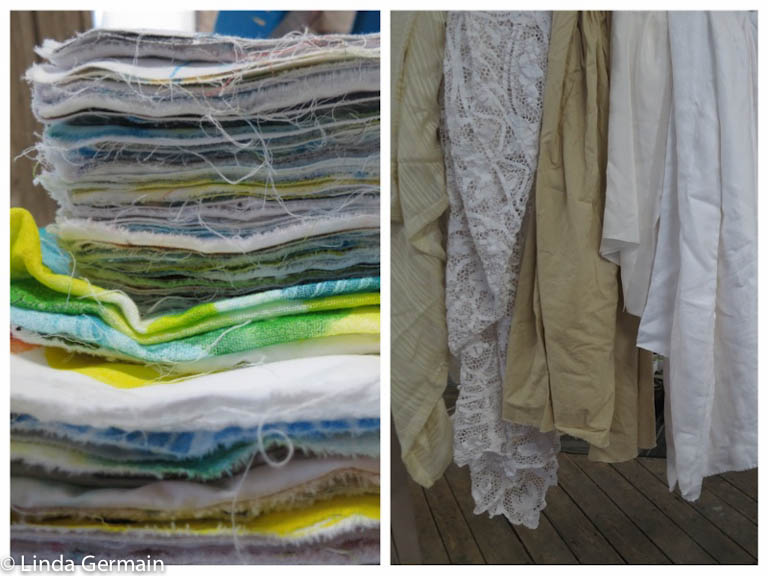
Collection of gelatin prints on fabric and a clothesline of light colored fabric for more printmaking
I believe the more prints I make, the better they get. With each print I learn something about
Layering
Texture
Color
inks
printing surfaces or
composition
I brought that stack of prints to the local laundromat to heat set the inks – 45 minutes in a hot commercial dryer. Then I stopped by the local thrift store and gathered up a few more big pieces of white fabric.
No matter how many pieces of fabric I tear to size and iron, I always need more. I like to work up 4 or more prints at a time.
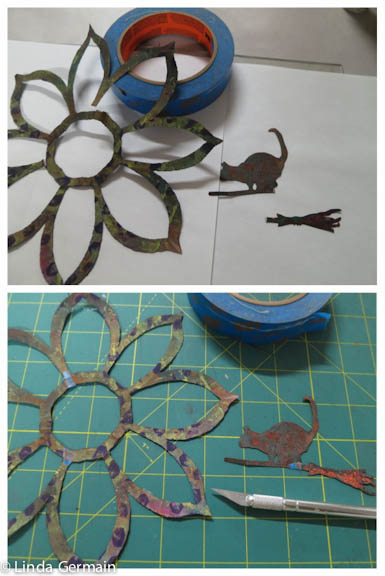
Tiny bits of tape to mend a stencil for gelatin printmaking
Sometimes a masking stencil gets moist and weak and breaks while you are pulling gelatin prints. Can you see the kitty cat has a broken broomstick? And the flower petal is separated from the center.
If you are like me, then you love to print and making stencils is work. So if one tears I fix it.
Get some strong tape
Self healing mat
Sharp exacto knife
Broken stencil
Now this is not a perfect fix, because your tape may show up in the detail impression. You may have to decide for your self if you like this tape method.
Line up the broken parts and
Put a small piece of tape on both sides
Use a sharp knife to cut off any excess tape
Now you are ready to print. If the tape affects your detail impression too much then you may have to cut a new stencil. Or maybe try glue to mend the stencil?
If you would like to explore using stencils and printing on fabric with the homemade glycerin and gelatin plate, then join us in the upcoming Monoprinting on Fabric, online printmaking course.
Enjoy a quick slide show of some recent monoprints on fabric.
There is still some room in the Monoprinting on fabric, online printmaking class, that begins January 12th. It would make a great gift to yourself and then you can get busy shopping for everyone else.
Have you wanted to create your own hand printed fabric for you art projects?
Do you love that tactile nature of working with fabric?
Do you love to experiment and see what happens?
If you said yes to any of those questions, then you will love Monoprinting on Fabric, the online gelatin printing workshop. Check out the details and email me if you have any questions.
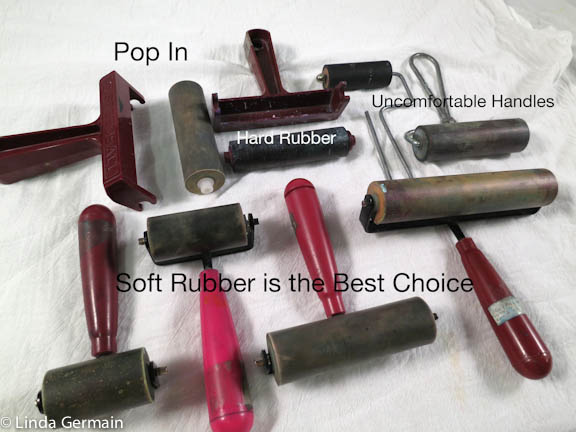
Not all brayers are created equal. There are several different types.
Soft Rubber Brayers are best for gelatin printing
But with any type you still want it:
To spin easily and evenly
To spin quietly ( squeaky brayer will drive you nuts)
Be comfortable to hold in your hand
To pick up and roll out ink in the desired fashion
You can find:
Soft Rubber brayers
Hard Rubber Brayers
Pop in brayers
Foam paint Rollers
For printmaking on the gelatin and glycerin plate you want soft rubber brayers. They pick up the ink evenly and release it on to the plate easier than the other types.
The other types of brayers or paint rollers are less expensive, but they will create frustration while trying to make monotype prints that you love.
The pop-in style do not spin as easily or evenly. The metal handled style can be uncomfortable if you are printing for a long time. Hard Rubber do not pick up and release as easily.
It is also great if you can have several brayers of different sizes. The speedball soft brayers come in sizes 1 1/2″ to 6″ widths.
It is nice to have a small brayer to get into tiny spaces. And a large brayer will give you better coverage with less lines when you are inking up a large area. You will waste less ink if you use the brayer that meets the size of your project.
Try to take care of your brayers. If you do they will last a very long time. Here are a couple of brayer care suggestions if you are working with water based inks:
While you are working try not to let acrylic or other hard products to dry on the brayer.
I keep a small container of water near by to drop my brayer in while I am setting up a print
Before you clean, roll off most of the unused ink onto scrape paper
Clean with tepid water and a few drops very mild soap
Be sure to get out all the ink from the cross bar and side pins.
If you let ink build up there, then the brayer will not spin as well
Gently dry them with clean soft rags
Rest them on the metal crossbar rather than the rubber roller
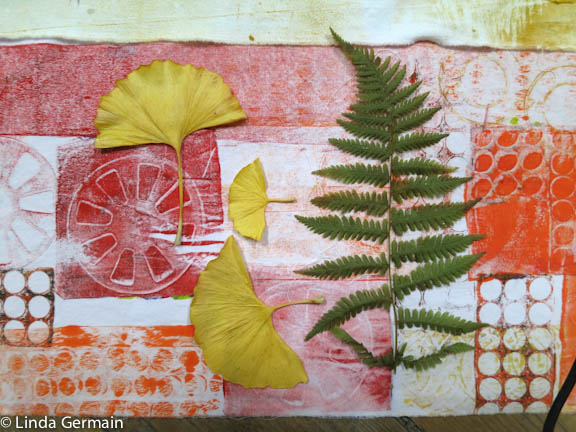
Natural Materials for monoprinting on fabric with the glycerin and gelatin plate
Autumn is coming to a close in New England. Last week I gathered as many leaves that I could find.
The were still on the tree, so fresh. I imagine that their little veins were still open and ready to drink up the glycerin and water bath that I was going to put them into.
I tried to collect at least 3 different sizes of the same leaf. I did this so when I print with them, I will have repetition and variety.
I left the leaves in the 2 parts water and 1 part glycerin bath for 4 to 7 days.
Then I stacked them in between the pages of an old phone book. Hopefully the phone book will absorb the excess glycerin.
I have been wondering where I could get leaves, ferns or grasses during the winter months.