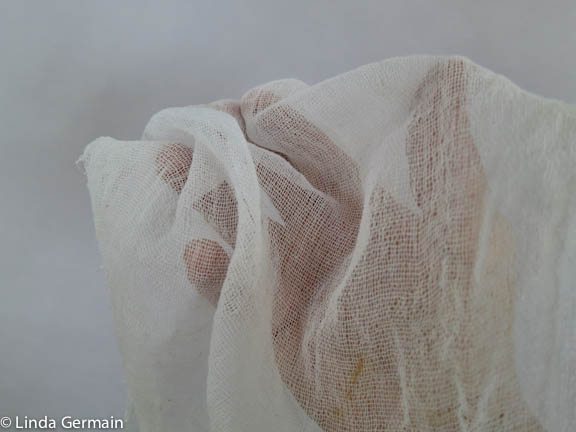
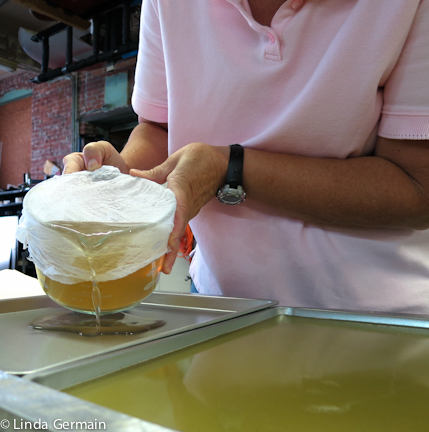
Tarlatan for straining the gelatin when recycling it.
Well traditionally a tarlatan is used for wiping excess ink off an etching plate.
It is an open weave, heavily starched fabric.
I use it in gelatin printmaking to strain recycled gelatin into a pan. It catches all the gunk and junk that was on or in the gelatin plate from weeks of printing.
Also sometimes the gelatin plate starts to mold as it ages.
The glycerin and gelatin recipe does not mold as quickly as the gelatin. I try to catch all those bits of mold in the tarlatan.
I have heard that some folks use a fine mesh sieve, old panty hose or doubled up cheese cloth.
So use what you have when you reconstitute your gelatin and glycerin plate.
If you would like to get lots of help making and maintaining your gel printing plate, then join the next session of Make Monotypes, the online printmaking course.
Many of these inks are not intended for use on fabric, but I had them around and wanted to see what would happen if I used them to print on fabric.
You know that I believe, “Fearless experimentation can lead to extraordinary results.”
The perfect ink for my application will:
roll out thin layer with brayer
hold the edge of a detailed mark
print very dark to very light
stay alive/workable as long as possible
non-toxic and low fumes
dry fixed on the fabric
allow fabric to remain soft and supple
Often is it not possible to do a quick test of inks when printmaking. Printmaking takes time and often the first few prints with a new ink are not so great. Each ink has a learning curve. What is good for one person may not work for another person.
You can make one change –
type of fabric,
type of plate,
weather and
speed of working and it could affect your results.
So these are just my opinions based on one or two weeks of test printing on fabric. Please do your own tests with your own goals and desires.
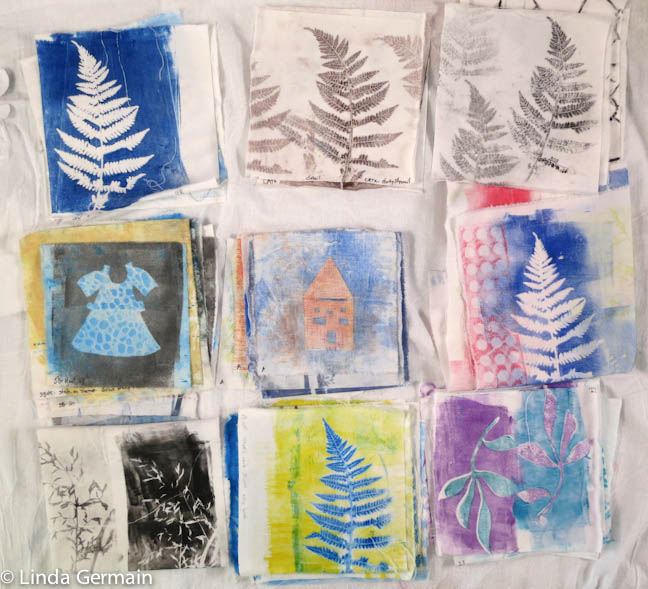
As you can see from the picture below, it is possible to get a pretty good print from most of the inks that I tried. Please note that I was working small and fast and doing the most I could to get a strong print.
Top Left counter clockwise, Golden Open Acrylic, Createx Screen Print, Speedball Screen print, Blue/red-Createx Monotype, Purple-Jaquard Textile colors, Yellow-Versatex Screen Print, Black-Speedball fabric ink, Blue dress-Speedball block Print, Center-Craft Acrylic
Here is a very short summary of my experience with these inks for printing on fabric with the gelatin plate.
Speedball water soluble block printing inks – water based- I printed on damp fabric and did a very quick dry/heat set with iron. May not be permanent.
Speedball Screen printing fabric ink – Ok but did not roll out as smooth as the Versatex
Speedbal Fabric block printing ink – oil based water soluble – I am sensitive to the oil base. Takes practice to get it to work with the water based gelatin plate
Versatex Screen printing ink for fabric and paper – My choice – It meets all my criteria above
Jaquard Textile Color – Second choice – it is a little too fluid, so it loses details.
Pro Chemical textile paint – may be a good choice but mine was too old. Give yourself a chance – don’t use old dried up inks
Createx Acrylic Colors – screen print or brush – Pretty good but coverage was uneven
Createx Monotype colors – Good but I am not sure if it is permanent
Acrylic Craft Paint – Not so good, stiff, dries very fast, sticks to the plate, but it is cheap and readily available.
Caligo Safe Wash relief ink – water soluble oil – did not roll up very evenly for me
Aqua Linoprint by Schmincke – water soluble oil – stuck to the plate and did not release on to the fabric
Daniel Smith Water Soluble Book Printing inks – water soluble oil – requires time to get to know the ink – pretty good coverage, but I hear they are discontinuing the product
Golden Open Acrylics – stuck to the plate and did not want to release on to the fabric, for that reason it was hard on the gelatin plate. I have seen it work for others using the commercial gel plate.
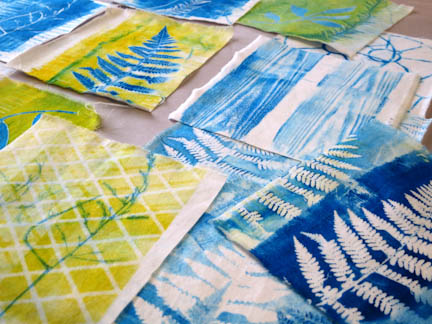
Gelatin Monoprints on fabric with natural ferns and leaves.
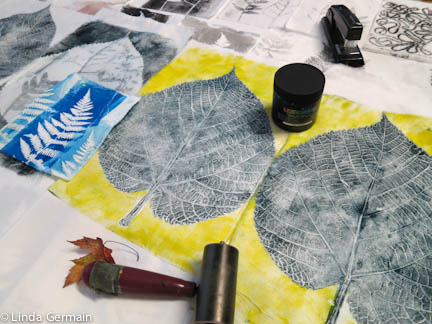
I am loving the glycerin and water bath to preserve ferns and leaves. I have realized that it is best to have mature but fresh vegetation.
I tried using a few leaves that I found on the ground and they were too far gone. The ends curled and the leaf turned hard in spots. Flexible and strong is what I like for printing on the gelatin and glycerin plate.
I am curious how long this huge leaf will last. I have had it on the workbench for 10 days now. That is much longer than if I had just pressed it in a book.
What is a baren and why would you want to use one to make gelatin plate prints?
I baren is a tool that is traditionally used in woodblock printing to apply even pressure to the block and create a crisp even transfer of ink. Gelatin plate is much softer than a carved woodblock, so we will not be putting the full force of our bodies into burnishing.
The reason I sometimes use a baren on the glycerin and gelatin plate is I want to apply a more downward even pressure. I hope with this even downward pressure I can create a more crisp, clear detailed impression.
Have you noticed that when you push on the gelatin plate it depressed and responds to your touch? Of course you have. That is what makes the gel plate so amazing.
Each time you depress the plate you affect the image/impression. The more things move the more fuzzy the print may become.
I have a speedball contemporary style baren, but I have experimented with other objects to see if they could be used in place of a really baren. I have tried:
flat bottom jars
flat bottom paint bottles
old porcelain door knob
Some say a wooden spoon will work. I always found them to be too small.
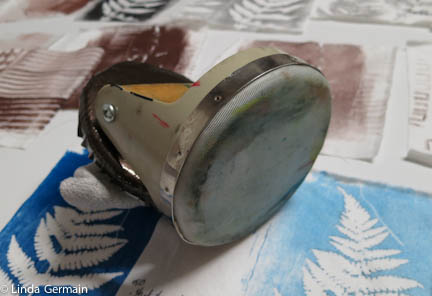
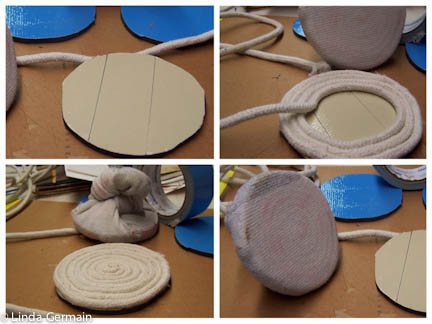
I made a homemade baren too. You can see from the pictures.
a homemade baren for printing without a press – Linda Germain
Cut a circle of stiff foam core
Cover the foam core with 2 sided carpet tape
Tightly coil clothesline rope on top of the tape
Craft a cover. I used an old tube sock, put the base about 1/2 way through, stretch tight and tie the ends together to create a handle
Finally, I added a sticky vinyl to the bottom, so it would slide more smoothly.