Love Line as a design Element

Line drawing in printmaking linda germain
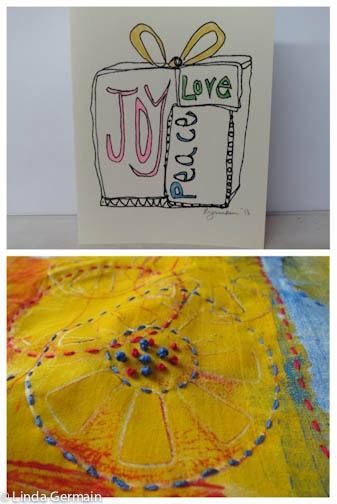
Simple line drawings can make powerful impressions

Line is often the first element of design that is taught in a basic art course. I love line whether it is simple and clear like the flower drawings of Ellsworth Kelly or the figure drawing by Matisse. (Do a google image search of the underlined terms and see if you agree)

Yet, I am also moved by the scribbles of Cy Twombly or some of the drip paintings of Jackson Pollock or the bold black brush strokes of Franz Kline.

  • We all use line everyday in writing.
  • We are familiar with it.
  • Very few materials are needed
  • Line can direct the viewer
  • It can guide you through a piece
  • It can connect elements of the piece

How do you feel about line? Love it? Or leave it?

Have you ever:

  • done gesture drawings of a live model?
  • contour drawings of every day objects?
  • made thick bold expressive marks with black paint?

Notice how you already use line in your art making. See if there is a technique or approach or style that you would like to play with.

Enjoy!

Love Line as a design Element Read More »

Adding hand work to gelatin prints on fabric

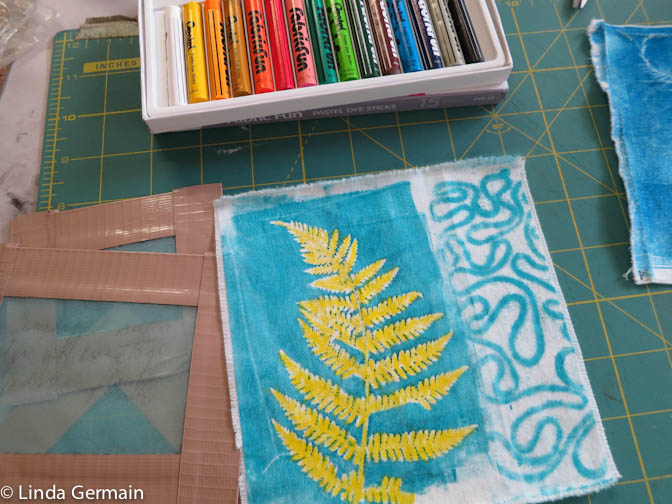
Yellow dye pastels added to gelatin plate print on fabric - Linda Germain
Yellow dye pastels added to gelatin plate print on fabric

I tried out some pastel dye sticks to add color to a monochromatic gelatin print. They seem a little “waxy” so I think I will use them as a last layer, too add a bit of accent color.

They can be heat set with an iron according to the manufacturers instructions.

Sometimes with gelatin printing it is a challenge to fill in a delicate white space with another printing method. That is when hand work and mixed media techniques can help.

If you would like to explore gelatin printmaking on fabric, with a great group of international artists, then sign up today for the online printmaking course, Monoprinting on Fabric. Read the details here.

Adding hand work to gelatin prints on fabric Read More »

Gelatin Prints on Fabric to Cover Journals

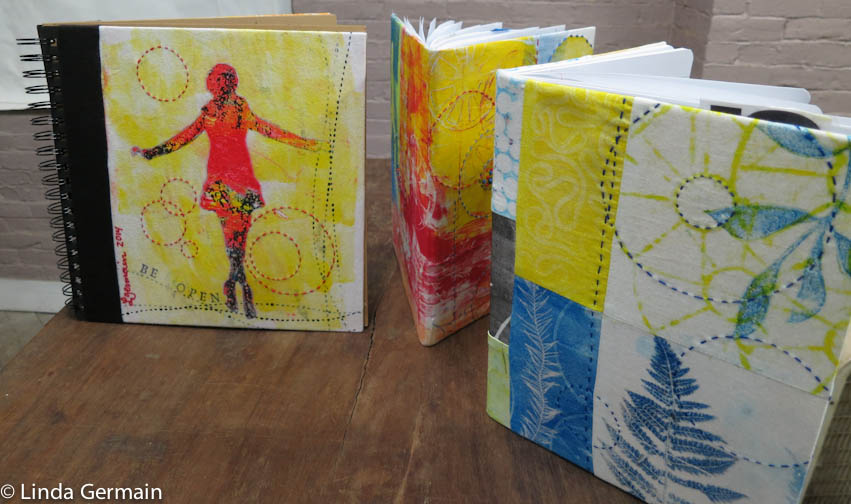
Books with Monoprinted Fabric - Linda Germain
Journals covered with Monoprints on Fabric – Linda Germain

As you may have noticed from yesterday’s post, I am creating quite a pile of monoprints on fabric. That is the way I approach my printmaking. I love to get lost in the process and make lots of prints.

It is great to get into the flow of printing and let one mark or impression inform the next. This exploratory approach does allow for lots of learning and “mistakes.”

I don’t really think of my “less-than-perfect” prints as mistakes, but more as prints with potential. If 10 percent of my work is amazing, then that is good enough.

I think that it is funny that I give myself so much attitude to “fail” when I am making art. {I wish this would carry over to the rest of my life.}

Most recently I am embracing the idea to start with what I know and can already do. For example, I was getting frustrated because I don’t seem to be able to free motion sew with my sewing machine. And I love the look and feel of free motion quilting.

After several good attempts, I set the machine aside and moved to the needle and some simple hand stitching. I will circle back to machine stitching maybe after I get some help.

Do you give yourself the space/time to make the mistakes necessary to really learn a new skill? Try it!

If you want some support in learning to print on fabric, then join us in Monoprinting on Fabric. Registration is open now.

Gelatin Prints on Fabric to Cover Journals Read More »

Piles of Prints on Fabric

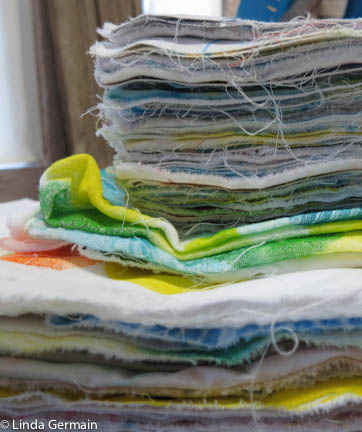
Collection of gelatin prints on fabric and a clothesline of light colored fabric for more gelatin printing
Collection of gelatin prints on fabric and a clothesline of light colored fabric for more printmaking

I believe the more prints I make, the better they get. With each print I learn something about

  • Layering
  • Texture
  • Color
  • inks
  • printing surfaces or
  • composition

I brought that stack of prints to the local laundromat to heat set the inks – 45 minutes in a hot commercial dryer. Then I stopped by the local thrift store and gathered up a few more big pieces of white fabric.

No matter how many pieces of fabric I tear to size and iron, I always need more. I like to work up 4 or more prints at a time.

Check the current workshop list for a class that would interest you.

Want to Hand Print Unique Fabric?

Join today and get notice of future classes.

You will also get weekly emails about printmaking, tips, tools and classes.

Piles of Prints on Fabric Read More »

Mend a stencil for gelatin printing

Tape to mend a masking stencil for gelatin printing
Tiny bits of tape to mend a stencil for gelatin printmaking

Sometimes a masking stencil gets moist and weak and breaks while you are pulling gelatin prints. Can you see the kitty cat has a broken broomstick? And the flower petal is separated from the center.

If you are like me, then you love to print and making stencils is work.  So if one tears I fix it.

  • Get some strong tape
  • Self healing mat
  • Sharp exacto knife
  • Broken stencil

Now this is not a perfect fix, because your tape may show up in the detail impression. You may have to decide for your self if you like this tape method.

  • Line up the broken parts and
  • Put a small piece of tape on both sides
  • Use a sharp knife to cut off any excess tape

Now you are ready to print.  If the tape affects your detail impression too much then you may have to cut a new stencil.  Or maybe try glue to mend the stencil?

If you would like to explore using stencils and printing on fabric with the homemade glycerin and gelatin plate, then join us in the upcoming Monoprinting on Fabric, online printmaking course.

Enjoy a slide show of some monoprints on fabric.

Mend a stencil for gelatin printing Read More »