Inks & paints for printing on Fabric with the Gelatin plate
monotype printing on fabric with the gelatin plate by linda germain
monoprinting on fabric with the gelatin plate

I am playing with all types of printmaking inks and paints for making prints on fabric with the gelatin and glycerin plate.

I am looking for inks that are compatible with the water based printing plate.

I am drawn to the type of fine detailed impressions that are possible on the homemade glycerin plate. I am always amazed at the fine details that are possible with mere hand pressure and the gelatin and glycerin plate.

It is important to me that the inks permit the printing of these types of detailed impressions.

The perfect ink will:

  • roll out thin layer with brayer
  • hold the edge of a detailed mark
  • stay alive/workable as long as possible
  • non-toxic and low fumes
  • dry fixed on the fabric

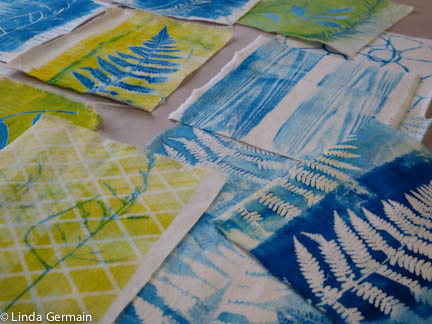
The monoprints in the photo were printed with the Versatex screen printing inks. I am pleased with these inks so far.  A bonus is that they work well with paper too.

These screen printing inks have a nice consistency and they roll up nicely on the glycerin and gelatin printing plate.

If you would like to learn more about Monoprinting Fabric with inks and the gelatin plate read all the details on the self study workshop page.

Inks & paints for printing on Fabric with the Gelatin plate Read More »
3 Tips for Choosing the Best Leaves for Monoprinting

compare leaves for their printmaking qualities - linda germain
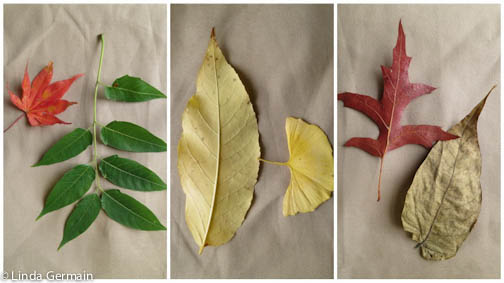
Can you identify which leaves will make better prints?

Lots of folks want to print with leaves, flowers and grasses. All natural materials are not the same. Some are better than others for printing on the glycerin and gelatin plate.

To get the most detailed and interesting impressions when making prints with natural objects I look for 3 qualities.

Printing with Leaves and Grasses

  1. Leaves with interesting negative space. That means I look at the shape around the leaf and ask myself it is interesting or boring.  Also if petals of the leaf touch each other then they will create one big space instead of separate petals. Do I want that?
  2. Texture on the back side of the leaf.  Are the veins prominent? Will they create a detailed mark? More mature leaves generally have more distinct veins.
  3. Strong but flexible.  Tender spring leaves usually flop and curl. They are hard to handle. Look for a sturdy flat leaf that with withstand, inking, moving and rubbing. Dried leaves are usually brittle and seem resistant to holding the ink.

Hope these tips help you with your next printmaking session with grasses and leaves.

Do you have other qualities that you look for when printing with objects from nature?  If so share them in the comments section and inspire us.

3 Tips for Choosing the Best Leaves for Monoprinting Read More »

Cover your journal with monoprinted fabric

monotypes on fabric - a project by linda germain
Quick and Easy project – Use monoprints to cover a journa and ENJOY!l

I have been wondering what the attraction is to working with fabric.

I think it has to be the personal, tactile nature of the medium.  You can feel it, touch it and even wear it.

Prints on paper are often under glass and we are discouraged from touching them.

Tell me in the comments: Why you love to work with fabric and printmaking.

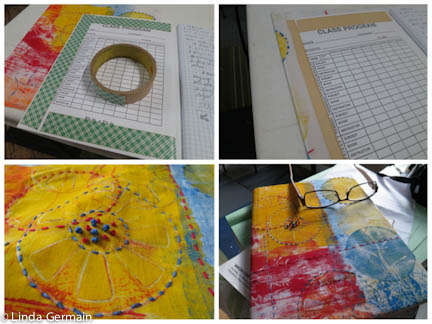
Here’s a quick tutorial:

  1. Put strips of strong double stick tape on the outer edges of the inside of the covers of a stiff composition journal.
  2. Cut your fabric about 3/4″ – 1″ bigger all the way around the open journal. So you have enough to cover the back and the front and wrap 3/4″ – 1″ to the inside.
  3. Wrap one edge over and stick it to the tape,  as shown in the top right image.
  4. Carefully pull the fabric taut and then stick it to the tape. You want it to be flat and tight, but not so tight that it warps your journal.
  5. Snip the fabric at the top and bottom of the spine.  This will allow you to get around the pages.
  6. You can get fancy and miter the corners, or just snip out some of the excess and finger press the fabric flat.
  7. You could finish the inside covers with more tape and fabric.  I simply pressed the first and last page to the inside covers.

Now I get to see, touch, and enjoy these monoprints everyday.

Interested in gelatin printing your own fabric? Check out the online class Monoprinting Fabric.

Cover your journal with monoprinted fabric Read More »

Thermofax screen printing kit available soon

Are you curious about screen printing?

Do you want to add thermofax screen printing to your art making skill set? If so, then you may be interested in this starter set of printing screens that I am working on.

WATCH this video and see how I quickly print and layer one piece of fabric with several images.

Join the special interest list for thermofax screen printing and I will keep you up to date about courses, kits and videos that I develop about this fast and fun printing process.

Thermofax screen printing kit available soon Read More »