Printing Projects for the Fabric Printmaking Course
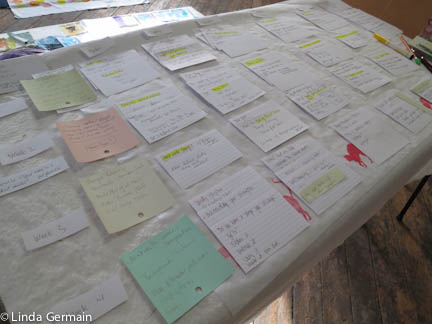
4 Week online course Printing on Fabric with - Linda Germain
Planning the details for Printing on Fabric Class – Linda Germain

I am pleased to share that everything is falling into place for the upcoming Fabric Printing Class – Make Monotypes – Focus on Fiber

The more I explore this process the more excited I get. I love to think of new ways to make marks with unexpected tools.

Working with fabric is much different than paper for me. Basic principles and tools carry over, but there are new challenges and new types of marks to take advantage of.

I have set the dates for the Online Printmaking Workshop, class will start January 12th and run for 4 weeks.

Early Bird Registration will open Friday, November 14th at 8:00 AM EST.  So mark your calendars and plan for some printmaking fun this January.

Here is the schedule:

Week 1 – Let’s Get Printing – optimize your workspace, make the gelatin printing plates, find some super simple tools and begin to make the most of your inks and marks

Week 2 – Mask and Transfer delicate marks – choose and preserve natural materials, cut and use stencils to block and transfer ink as desired to create those amazing details that are only possible with this gelatin printmaking process

Week 3 – Make the most of your brayer, identify and create stamping tools that will print best on fabric, transform a small printing plate and create a large printed cloth

Week 4 – Play with painted and brayered abstracts, create textured backgrounds, explore alternative plate use and what to do with less than perfect prints. Identify your strengths and preferences and embrace your new printmaking skills.

Tell me what would you do with all your monoprinted fabric? Would you make quilts, wall hangings, mixed media art, embellish other fibers with it?

Printing Projects for the Fabric Printmaking Course Read More »
Monoprinting large piece of Fabric

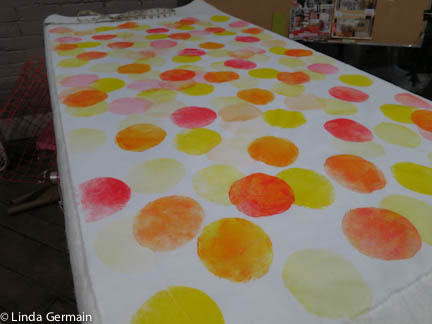
A yard of monoprinted fabric - Linda Germain
A yard of monoprinted fabric – Linda Germain

The gelatin and glycerin printing plate is small, but that does not have to limit the size of the fabric that you want to customize with your own design.

In this piece, I use a small round piece of the gelatin plate and used it like a stamp to print several layers of circles.

Things to do when printing a larger piece of cloth:

  • Iron the fabric
  • Set up a slightly padded surface to print on
  • Stick the small piece of gelatin to a small piece of plexiglass
  • Ink the plate and stamp away

Use your imagination and play!

If you would like to explore this process with a group of like minded artists then sign up for the special interest list below.

Registration for:

Make Monotypes – Focus on Fiber – Printing on Fabric will open soon.

Want to Hand Print Unique Fabric?

Join today and get notice of future classes.

You will also get weekly emails about printmaking, tips, tools and classes.

Monoprinting large piece of Fabric Read More »

New Monoprints on Fabric with Screen Print ink

I have been busy pulling monotype prints on the homemade glycerin and gelatin printing plate.  This is getting to be more fun everyday.

I did a quick video of a bunch of test prints. Watch it and be inspired. I used the Versatex Screen printing inks in most of these monoprints.

I am happy with the density of coverage of the ink.  It dries in a day or so and can be layered then.

New Monoprints on Fabric with Screen Print ink Read More »

What can you do with 25 pennies?

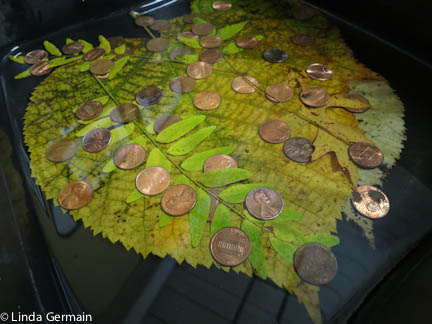
Sink leaves in water and glycerin mix for 2 to 3 days to preserve.
Submerge leaves in a water and glycerin bath for several days to preserve.

I know you have jars, cups and containers of those pretty pennies.

I do!

We can’t buy much with 25 pennies these days. So let’s put those pennies to work.

A couple of my students shared with me that they preserve leaves with a glycerin bath.

So I googled the process and found that you mix 1 part glycerin to 2 parts water and to submerge the leaves for several days.

This is where the pennies come in. I used the pennies to weight down the leaves and ferns.

It takes some planning and patience. But I am encouraged by the results.

I preserved a fern this way and used it to print with screen printing inks on cotton fabric, with the glycerin and gelatin plate.

I think these steps will help the process:

  • Choose natural materials that are still a little green (not dried up)
  • Smash the end of the stem to open it up and aid in the absorption
  • Be patient
  • Blot them to remove the glycerin bath
  • Store them flat
  • Use a shallow flat plastic container and cover with a sealed lid to save the bath for another day

What can you do with 25 pennies? Read More »

Printmaking tools just outside my Door

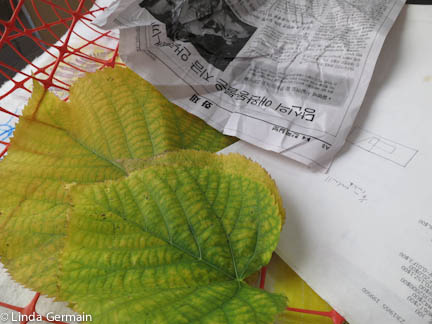
Construction fence, japanese newspaper, sketch from the machine shop and some huge leaves - all for printmaking play - linda germain
Construction fence, japanese newspaper, sketch from the machine shop and some huge leaves – all for printmaking play – linda germain

Today, I decided that I was going to have some fun, explore a bit and see if I could find some printmaking inspiration.

With the intention set, I began my day.  Just a few steps outside my studio door and I began to find some “new” printmaking tools.

  1. Construction fencing will work great for what I call a “brayer rubbing”
  2. The giant leaves are soaking an a glycerin and water bath to preserve them.
  3. Chinese or  japanese newspaper from the recycle bin next door.
  4. A sketch from the machine shop

My day had barely started and I had already collected more than enough printmaking tools for experimentation.

I printed with Jacquard Textile paints to create some monoprints on cotton fabric. These paints are more fluid than the Versatex screen printing inks that I tried yesterday.

When the printmaking ink/paint is more fluid, then it may not be able to hold the detailed impression. The ink/paint starts to run together and the resulting monoprint can be somewhat fuzzy.

This detail impression is very important to me. It is what makes printing with the glycerin and gelatin plate so amazing. Fine detail similar to an etching is possible with mere hand pressure and the right stencil material.

Check the current workshop list for a class that would interest you.

Printmaking tools just outside my Door Read More »