Try a Simplified Trace Monotype print

The sale class this month is Draw into Print. In this class, we explore several ways to create trace monotype prints. Read the details on the workshop page.

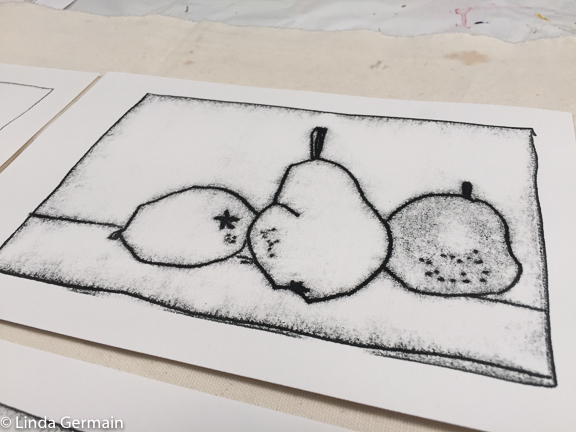
trace monoprint - pears

I have been exploring an even simpler way to incorporate trace monotype prints into my sketchbook.

simple trace monotype print

Sometimes I don’t want to get out a lot of tools and would like a quick little way of making a print.

For this simple process, you just need some water soluble oil pastels, wax paper, masking tape and simple line drawings.

trace Monotype print water with soluble pastels

The first step is to make some simple drawings on small sheets of paper that you would like to make duplicates of.  Do keep the lines, simple, and clear.  This process would be more difficult with a very detailed drawing.

Simple line drawings for transfer

To create the transfer paper, we are going to heavily coat the wax paper with a layer of water soluble oil pastel. You could use any color that you like, but to get the traditional, fuzzy line, mark like a trace monotype print, I use black.  This trace paper can be used over and over again. You will just need to re-coat it with the water soluble oil pastel every so often.

Trace paper made with water soluble oil pastels

To make the trace monotype print lightly tape the trace paper onto your sketchbook. “Ink/pastel” side facing down.  Then tape your sketch on top of the trace paper and firmly trace over your line drawing. It works like carbon paper of the olden days. 🙂

Trace monotype print horses

Be careful to keep the papers in place so that your lines will match up. You may have to experiment with the amount of pressure needed to transfer the line. But I think you’ll be pleasantly pleased with your results.

One benefit of using the water soluble oil pastels is that they are somewhat resistant to watercolor. And I love to accent the drawings with a bit of loose watercolor to complete the image. Hope you enjoy this technique.

If you want to explore trace monotype printing in depth, check out the details of the online class Draw into Print, the sale class for this month.

Sketchbook page with trace monoprint techniques

Try a Simplified Trace Monotype print Read More »

Safety of a sketchbook practice

Your sketchbook can be a safe place to do nothing or everything. It is a place where you can make marks, sketches, collages and doodles.  And nobody else has to see it, unless you want them to.

Sketchbooks by Linda Germain

Recently, I have been working in separate signatures that I put together when they are  finished. This way, I can work on several wet pages at once. I like to use inexpensive watercolors and paint circles and stripes and dots. These marks become foundation for other marks.

journal spread

Sometimes, I will go through and collage a piece of paper on each page just to get started. I often write my angels of the day on a page just to stimulate thought.

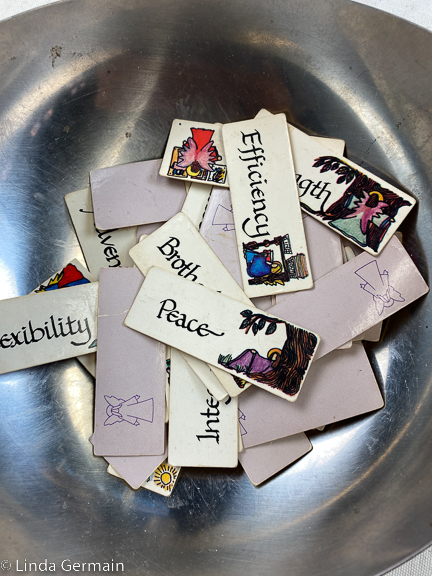
I have a bowl of ideas that I can pick a cue card from and get started.

Bowl of sketchbook prompts

I approach this process in a very nonlinear way. Working randomly through the pages of each signature, as I am inspired to make new marks. I have common motifs that I refer to often. These include birds, flowers, horses, trees, and houses.

Sometimes I start a page with just horizontal or vertical lines.

Despite this random approach, each book is a record of that month’s, inspiration, and ideas. And often it is a cohesive expression, even though it is a very random collection of sketches, drawings and doodles.

I like to use very simple materials like crayons, pens, markers, and inexpensive watercolors.

Use simple watercolors

I have tried several different sizes of pages for this journal, and my favorite is 6″ x 6″. It’s not too big not too small and seems to be the right format for me.

Finished sketch books

I think the sketchbook ends up being part diary and journal and part sketchbook. I have been using this random sketchbook format for a couple of years now, and have quite a collection. I generally finish about one book a month. Each book is 84 pages long. It is six signatures of 14 pages each. And I glued the signatures back to back to create one book. And then I make a loose sleeve to cover the whole journal.

If you would like some inspiration and ideas for your own journal, then check out the mixed media retreat. It is an online course and still on sale.

Safety of a sketchbook practice Read More »

Even More stamping ideas

I have been enjoying making lots of tiny stamps for using in my sketchbooks. The summer weather has inspired two new motifs rocks and sailboats.

My inspiration comes from my sunfish sailing at the beach in New Hampshire.

It is a rocky shoreline and I am always collecting interesting beach rocks.

I was inspired by the stacks of rocks the I see on the beach. At first I played with crayons and watercolors to make my stacks.

stack of rocks

Then I remembered my roundish foam stamps. I combine them with thread and crayon resists. And then added some charcoal scribbles to a happy result.

stamped rock shapes

Yesterday, I enjoyed cutting out tiny sailboat stamps from craft foam.  A technique I teach in the Stamp Making + Books class. Details here.

sailboat stamps

The stamp making process is quite enjoyable and addictive. You can create several unique stance very quickly that can be incorporated into your sketchbook practice.

sailboat stamps

How is the summer season influencing your art making? Enjoy!

Even More stamping ideas Read More »

Bits and Pieces – sketchbook Practice

My sketchbook practice is always evolving. It is kind of funny because I don’t really love to draw, but I find myself choosing to draw and doodle a lot in my sketchbook.

sketchbook drawings

I make a lot of unrelated marks that in the end seem to come together in the end.

sketchbook page

I do add plenty of stamped marks and pattern like marks. I collage little bits and pieces here and there and move back and forth through the signatures.

add stamped marks

I work up the signatures individually and then glue them together when I have most of the pages done. This way I can keep working in the sketchbook even while wet media is drying.

I have common themes here throughout most of my sketchbooks like birds trees, other animals and positive phrases.

sketchbook

Usually, I will couple of angel cards with those positive words in my sketchbook with the date. It gives me a starting point, and something to think about. It is fun to look back and see what I was working more each month. I do finish about one sketchbook per month.

This month I have included lots of old book pages and parts as inspired by the Books as ART Materials class. It is the featured class for the month of June. You can save $30, now only $95 for this 18 project class.  Get all the details on the workshop page.

Bits and Pieces – sketchbook Practice Read More »

Fun with Books

I have been exploring ways to use books and book parts as art materials. (This Months featured class – On sale save $30 – now only $95)

book pages and cloth as collage materials

Above I used part of a black out poem and book cloth and book pages for collage.

hunting for books to take apart

I love hunting for books with special qualities. I like the large font of children’s books. I am lucky to have a great thrift store close by that sells 6 books for just $1.00.

spine cover with book pages

Today I borrowed the spine cover idea from one of the 18 projects in the Books as Art Materials class for my current sketchbook. These signatures are worked up separately and then glued together.  The book page spine cover will give it a nice finish.

Black out poems from book pages

Black out poems are always fun and an easy way to get started.  Sometimes I cut them up and use them as collage bits.

drawing reference

Lastly I am inspired by images in books. I love finding new ways to draw trees. So take advantage of the June sale and enjoy the 18 projects in Book as ART Materials. Get all the details on the workshop page.

Fun with Books Read More »