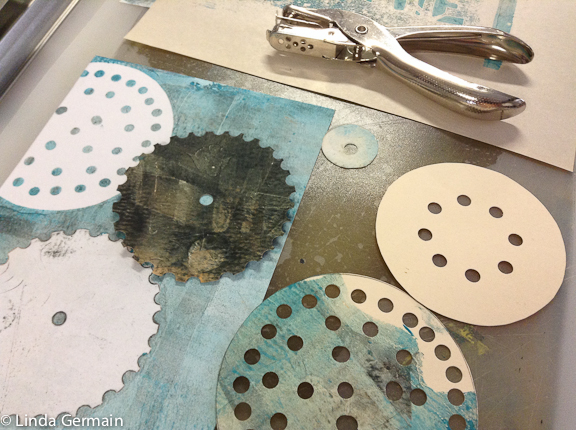
What would you do with a simple hole puncher and a manilla file folder?
You could make some masking stencils to use with gelatin plate printmaking. These files folders are a little more sturdy than paper, so the stencils will last longer.
Think of creative ways to use the hole puncher:
line of hole on the edge
fold the paper and punch a hole in the middle
fold the paper to reach other areas of the paper
Punch only 1/2 the circle to get a gear tooth effect
Cut your paper in different shapes
I got you started, so now cut a few new stencils do some creative hole punching and try using them with the gelatin plate.
If you want more guidance with working with the gelatin plate and making prints, then join us in the next Gelatin Printmaking Workshop – the 4 week class starts, September 19th. Read all the details about this online printmaking workshop here.
Make a Glycerin & Gelatin Printing Plate Now!
Get the FREE recipe to make a gel printing plate
Additionally, you will receive a weekly email about printmaking, ideas, tips and courses.
You can explore printmaking at home with out a printing press and still be excited about the prints you pull. You can even do it with your grandkids or other artist friends.
If you are interested in developing your compositional skills, then you may want to try gelatin printing. Pulling prints is so fast that you know immediately if your design and compositions are working.
You quickly learn about:
division of space
leading the viewer around your print
variety and repetition of marks and images
I find there is a dynamic balance between play and guided discovery when making gelatin prints. This makes learning fast and fun.
If you have not tried gelatin printmaking yet, then do it today! Get the free recipe for the long lasting gelatin and glycerin plate.
I am all about experimenting with whatever tools, inks, papers and plates are in my studio. This leads to much “failure” and eventual success.
I say that if I get 2 out of 10 prints that I love then I am doing good.
I want to share with you my experience with different inks, on paper with homemade gelatin plate. All combinations will work to give you some kind of printed impression. So there is no wrong way, just different ways.
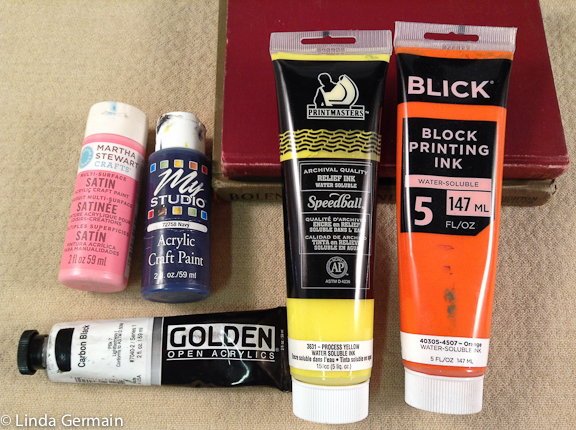
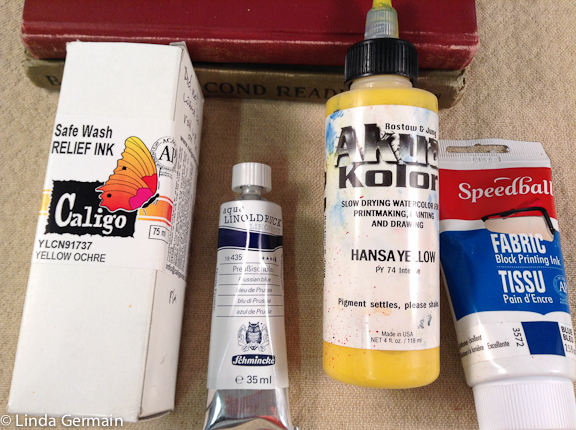
I am going to talk about my experience with Speedball Water Based Block Printing ink, and Golden Open Acrylic paint and basic acrylic craft paint. I think these are the easiest products to find.
Acrylic craft paint
It is inexpensive and easy to find. However it dries very quickly and it may be too fluid to hold the edge of a detailed mark. Don’t let craft paint dry on your brayers, it will ruin them.
Detailed impression – focus on the ink/paint left under the stencils
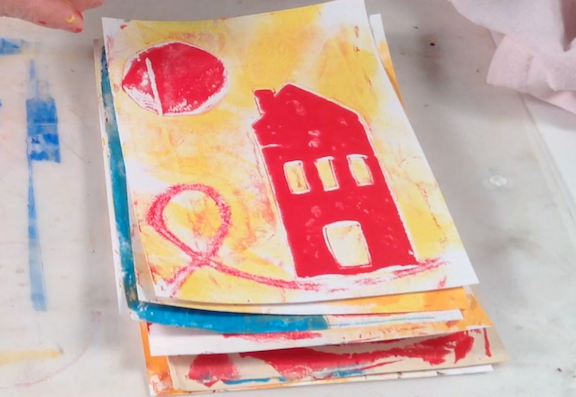
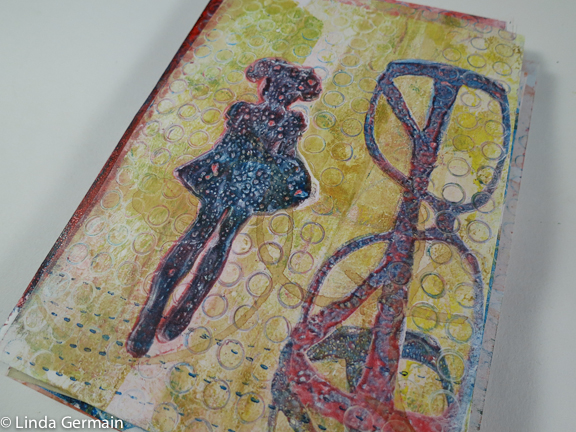
This red house print was made on a gelatin plate with craft paint and it features the detailed impression, the second print made with the ink that is left under the masking stencils.
Golden Open Acrylic Paint
This paint is designed to stay “open” wet for a longer period of time. It does not dry as fast a craft paint. It is very richly pigmented and on the expensive side. It is still a paint and not an ink.
It is very popular with many mixed media artists. I find it sticks more to the plate than my paper and still dries too fast. You may be able to add a bit of water to get it to release from the plate and on to the paper. And make sure you clean your brayer right away.
If you have some of these paints, try them and see if you get some prints that you like.
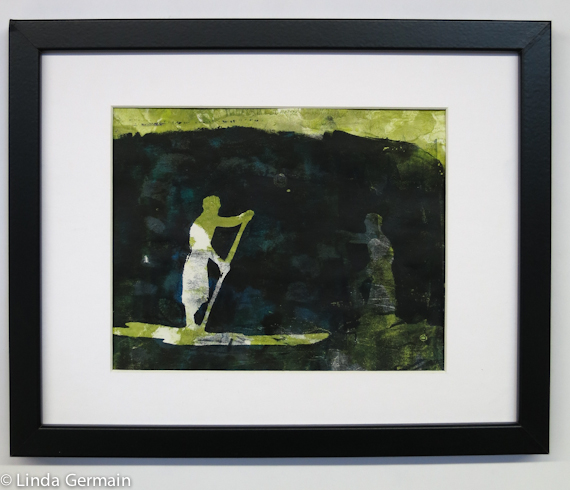
The print above was made with the Golden Open Acrylics.
Speedball Water Based Block Printing Ink
These water based inks can be found in some craft store and most online art stores. They are moderately priced. It does take some time to get to know how to roll them out and to ink the brayer and plate.
They do not dry fixed. So if the print gets wet the image will smudge, as with wet collage methods. One draw back is that they are a school grade ink and the richness of the pigments are just adequate. There is a richer pigment in the process colors of the Speedball Printmasters Block Printing Ink.
These are my favorite inks to use for gelatin printmaking. The ink stays alive and generally moist enough to transfer the ink from palette to brayer to plate to stencil and finally to paper. This allows for good detailed impressions.
They are non-toxic, very easy to clean up and will not damage your brayers if the ink dries on them.
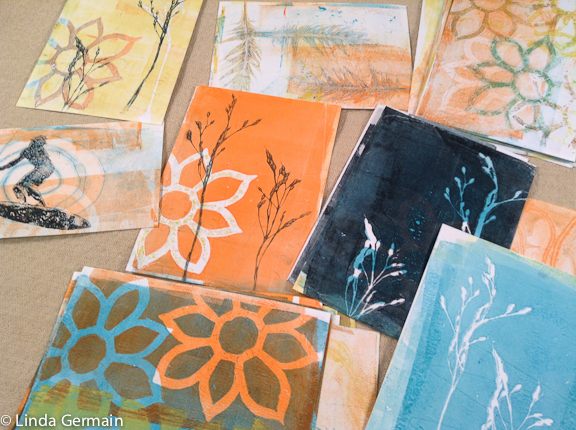
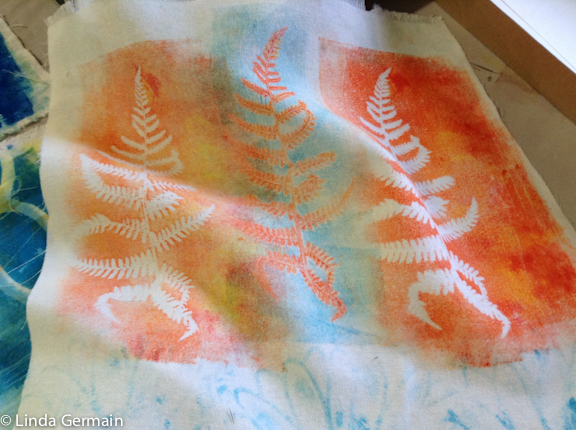
The gelatin plate print above was made with the speedball water based block printing inks.
Water soluble Oil based Inks
I have very briefly tested some oil based yet water-soluble inks and have trouble getting the oil based inks to stick to the water based gelatin plate.
It might work, but you may need to do some trial and error experimentation with modifying the inks with a spritz of water.
I am super sensitive to oil based inks. I used to be able to use them, but now it makes me wheezy. I loved the Daniel Smith water soluble block printing inks, but they are no longer making them.
The benefits of a water soluble oil based ink are that it dries fixed and generally the pigment is richer that a water based ink.
The Akua Kolor shown in the image above(now called Akua Liquid Pigment), is a soy based pigment and dries by absorption into the paper. It is highly pigmented, on the expensive side, and I do know of some artists who like to use it for gelatin printmaking.
I find it still sticks to the plate more than transfer to the paper. Clean up is a little more labor intensive. But it does dry fixed to the paper.
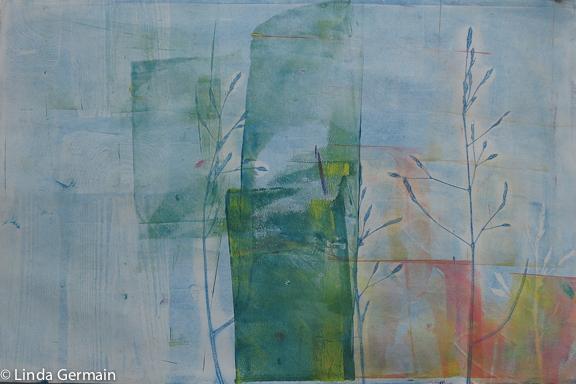
The print above was made using Akua Liquid Pigments and the gelatin plate.
I hope my experience helps you.
There is no one best ink. It will depend on many factors:
type of plate you are using
type of impression you want to create
any allergies you might have
how much money you want to spend
if you are willing to experiment
One rule that could guide you as well: Oil and water don’t mix. If you are using the water based gelatin plate then oil based inks will probably bead up.
Anther helpful skill is to learn how to ink your brayer smoothly and evenly. This takes time and practice.
If you want to explore monotype printing with the homemade gelatin and glycerin plate, water based inks and paper then check out the current workshop offerings.
Join the list below, get the plate recipe and notice of future classes and discounts.
Make a Glycerin & Gelatin Printing Plate Now!
Get the FREE recipe to make a gel printing plate
Additionally, you will receive a weekly email about printmaking, ideas, tips and courses.
Do you work hard to make a drawing that you like? I do.
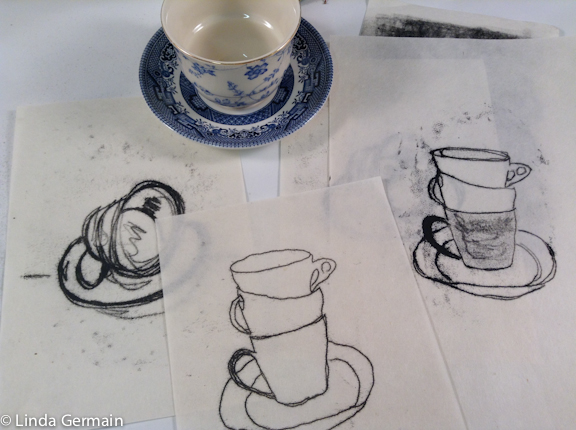
One way to make your drawings live on is to use them to make trace monoprints. This is an easy low tech way of printmaking without a press.
I love taking a drawing and using it to make mixed media piece of artwork. I think the beauty of a line drawing is that it let’s the artist’s hand show through.
I love when then energy of the moment is captured in a quick gesture drawing. For me it can take 20 or more drawings to get one that I like. But I don’t mind. I know that the whole time I am building my SEEing skills.
Drawing is about really seeing what is in front of you and then flattening that 3d image into a 2d drawing. I think that their can be a lot of baggage and rules around what is a “good” drawing. That pains me.
The whole, “I am good enough,” conversation can get in the way of fun and learning. One way to start believing that you are good enough is to look at what “good” drawings are on exhibit in the modern museums, look at some art history books and see what they call “good.”
Then find a famous artist who you admire and study her/him. Copy some of his/her drawings, as studies. That is what the old master’s did. Keep it fun!
 What would you do with a simple hole puncher and a manilla file folder?