2016 Year End Review in Pictures

Happy New Year!

I scrolled through my 7300 pictures and did a 1 minute slide show of things that make me smile in 2016. Enjoy!

2016 Review from Linda Germain on Vimeo.


Hope you had a wonderful 2016 and holiday season. If you are ready to start monoprinting on fabric, then you are in luck.

Class starts next week and you still have time to join this printmaking workshop. (It is the only time it will be offered in 2017)

Read all the details and register on the Printmaking workshop page.

2016 Year End Review in Pictures Read More »

Add hand sewing to Monoprinted fabric projects

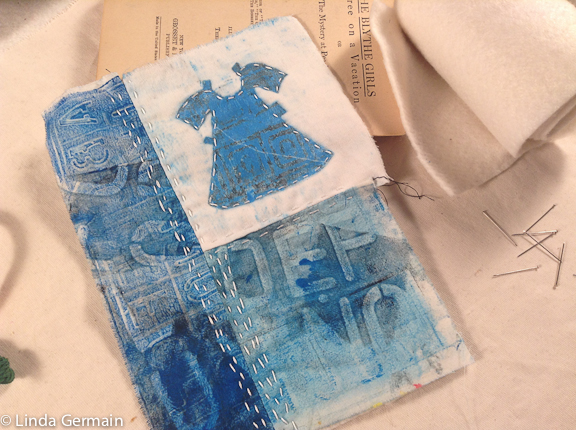
Hand sewing can be as simple as the running stitch. It may be simple but a few stitches can really transform a printed fabric project.
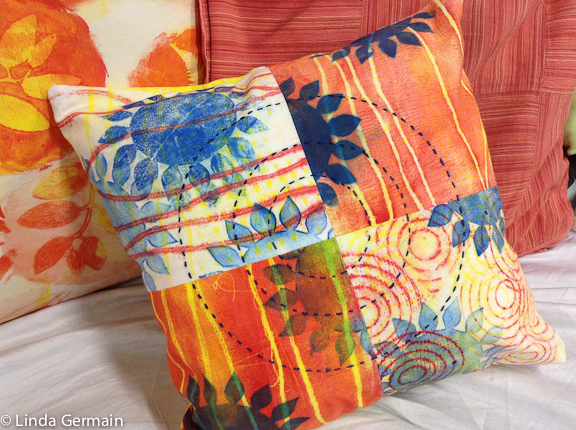
monoprinting fabric with hand stitching

For this pillow cover I pieced several monoprinted squares of cotton together.

Then I used the circle motif to repeat an underlying elements and unify the the design. The ideas evolved as I printed the fabric, pieced the squares and finished the pillow.
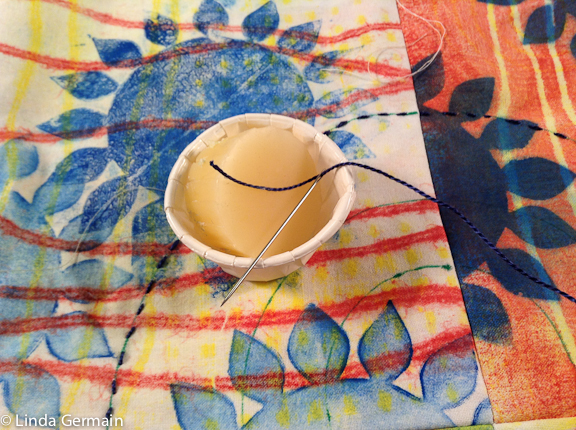
waxed the tip of the thread

I used a little wax on the end of my embroidery floss to get the fibers to stay together for a little easier threading.

I got the idea from my bookbinding tool kit. We use this chunk of beeswax to coat the thread for book binding. Just pull the end of the thread through the cold wax a few times and smooth with your warm fingers.
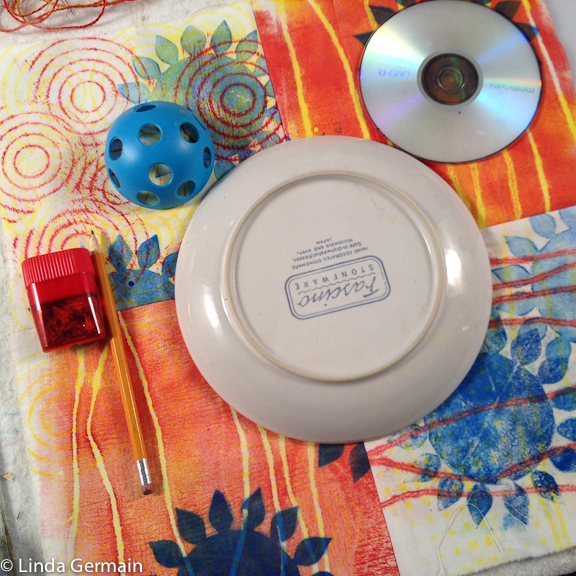
circle making tools from the studio

I found some round circles from around the studio to make my sewing lines. I traced a small plate, a cd and a whiffle ball, to make 3 different sized circles.
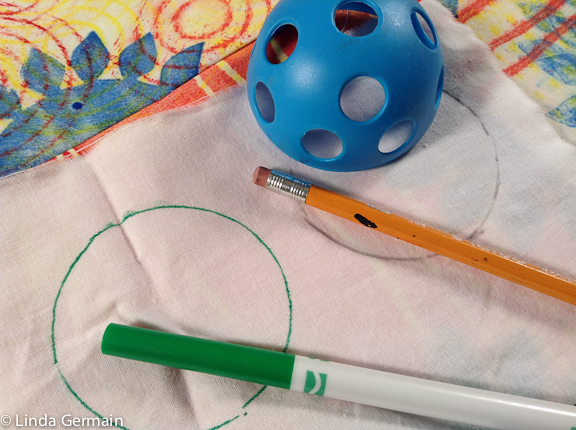
used water based marker to make the sewing lines

I tested my green water based marker first on a piece of scrap fabric. I wanted to make sure that I could easily rinse out the sewing lines when I was done. The pencil did wash out but it required more scrubbing.

Be sure to test your marking tools before you draw on your original art work.
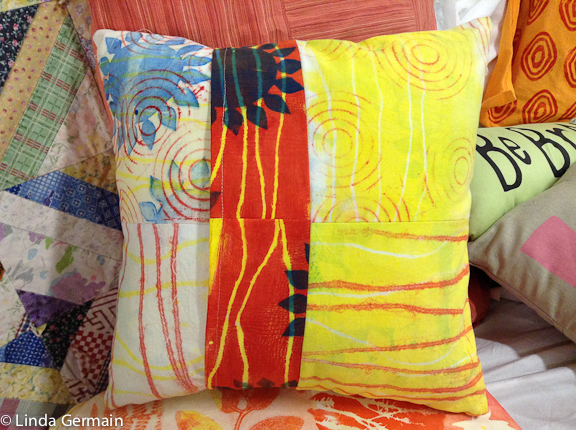
back side of hand printed pillow cover

I was pleasantly surprised with how the back side of the pillow cover turned out. I used the bolder solids on the back. I think it works. There is some variety and repetition of marks and I like how the pieces of fabric are different sizes.

Want to make your own monoprinted pillow cover?

YES! then check out the online self study Monoprinting on Fabric.

Students are getting a lot from Monoprinting Fabric Course

kathyirving-2 happy printmaking student

Monoprinting Fabric is an enjoyable and valuable learning experience. I will miss the daily anticipation of what new technique was coming next.

Linda provided an excellent foundation to build on, and I am grateful for her expertise and willingness to share it with us. I look forward to another class with you. Kathy I. from the US


Monoprinting on Fabric has been a fabulous course. There is a lot there to keep me going for a very long time. I love your teaching style, very encouraging, supportive, clear and fun. Patricia G. from the UK
Add hand sewing to Monoprinted fabric projects Read More »

It’s hard to Keep it Simple

I had this idea to pull 10 8″ square monoprints on fabric and to keep it simple and bold. Well that was the plan.

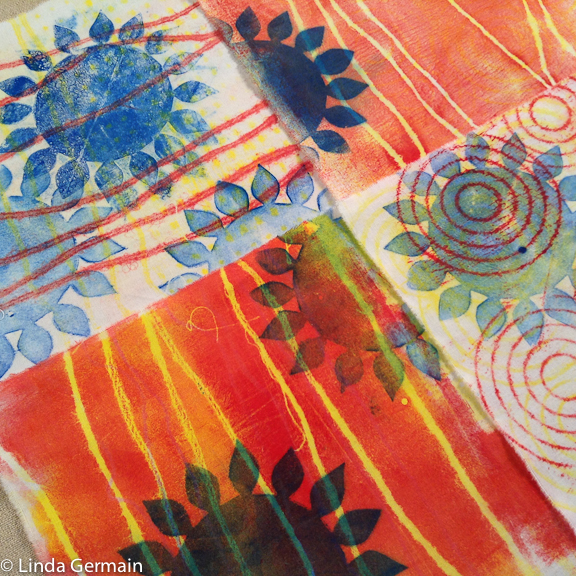
monoprinted fabric squares by linda germain

Simple is hard!

When I got to the stage above, I still wanted more and I wanted to quiet down the colors. Sometimes layering can dull down colors that are too bright.

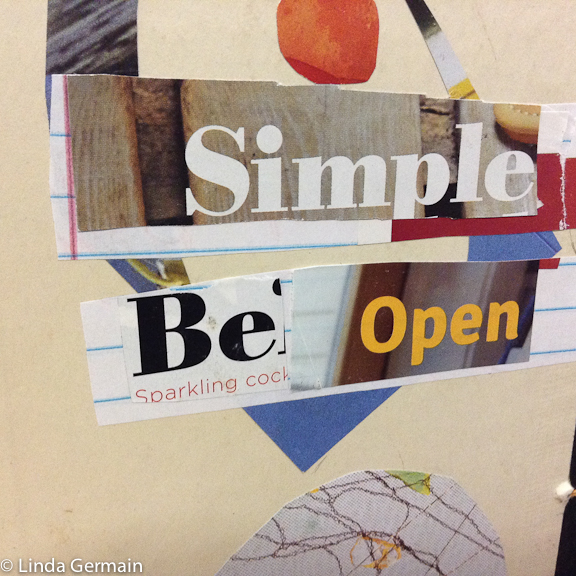
Be open to simple Linda Germain

I added a new shaped element and the blue layer. I had 2 stencils the “hole stencil and the masking stencil. Unpredictable marks happened and I was able to do a quick wash out of some of the squares.

But I realized I needed to let go of my original plan and go with the flow.

hand printed pillow fabric by linda germain

So I am not done yet. I think I might piece some of the squares together for the pillow top and then see if some stitching could unify the squares.

If you would like to explore monoprinting fabric with the gelatin plate, then read the details on the printmaking workshop page and join us today.

Printmaking Class starts Jan 9th

Artists are loving the course

Gelatin Printing on Fabric Loved it! 3 key approaches I have learned

  • bubbles/imperfections in the gelatine plate can be a good thing – it does NOT have to be perfectly smooth,
  • doing a brayer rubbings on a piece of fabric and
  • finally being able to get a coordinated set of prints.

Thank you everyone in the class for your comments and adding to the learning process. Erin J. from Australia


linda-germain-2


Monoprinting Fabric has been a wonderful class…so well presented.

I have thoroughly enjoyed it!

from Candee L from the US


As a member of Monoprinting on Fabric you get:

  • 4 weeks of video lessons every Monday thru Friday you will receive a private video
  • 20+ short actionable videos to get you printing right away
  • Personal support and feedback as you need from Linda Germain
  • Anytime access to the classroom for 6 months after the course ends
  • Ability to download any or all materials/videos for life long personal use
  • Choice to be a member of the private Facebook group

Read the details and join us today! This is the only time this course will be offered in 2017.

It’s hard to Keep it Simple Read More »

Piecing hand printed fabric

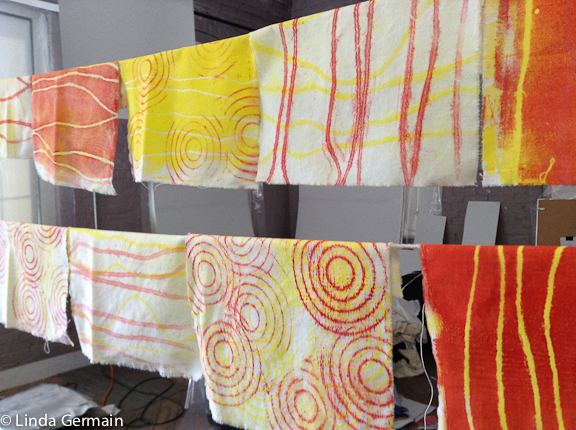
Often I print small pieces of fabric that can be combined to make mixed media art pieces.

monoprinted fabric pieced together for art project

There are a few things that help create fabrics that will work together:

  • Use the same weight and type of fabric
  • Pull some very dark and very light value prints
  • Use tools and imagery that has some variety and repetition of scale

I don’t always follow those guidelines and then I end up with lots of fabric that does not work well together.

hand pieced gelatin monoprinted fabric

This small wall hanging was fun to sew together. I used a little warm and natural batting as the backing. It was very easy to sew and the primitive hand stitching shows off the texture of the fabric.

If you are interested in exploring Monoprinting on Fabric then you are in luck. The online printmaking workshop starts soon. READ the details on the workshop page.

Artists are loving Monoprinting on Fabric

linda-germain


I have really loved this course Monoprinting on Fabric and I have learnt heaps.

You are very inspiring. I like your friendly and no fuss style.

Linden L. from Australia


Read the details on the printmaking workshop page and register today.

Piecing hand printed fabric Read More »

No sew hand printed mug rug

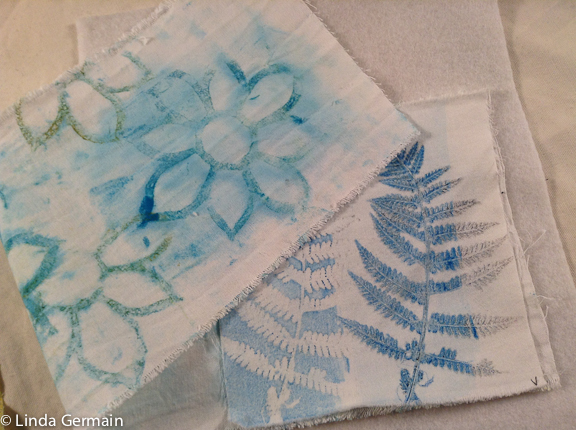
I like using my monoprinted fabric is ways that allows me to enjoy it everyday. Today, I used two pieces of fabric and a bit of felt to make a “Mug Rug”. You could call it a coaster or maybe even a potholder.

gelatin printed fabric for coasters

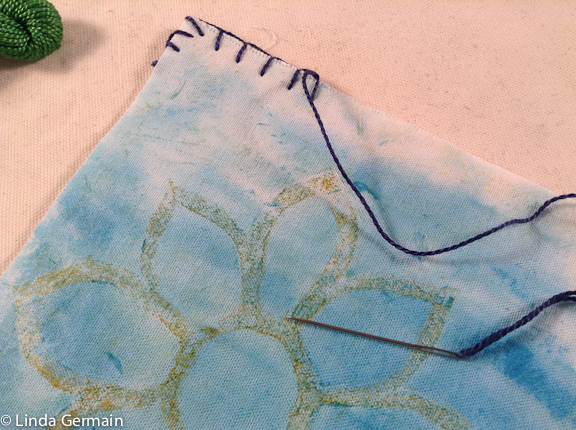
I used some simple craft felt in the middle and Heat-n-Bond to adhere the fabric prints to the felt. The fusible Heat-n-Bond gave it some stiffness, but it also was harder to sew through, when I did the blanket stitch around the edge.

blanket stitch the edge of monoprinted fabric for a mug rug

I would say artist’s choice on whether to use the Heat-n-Bond and whether to machine or hand sew the edge.

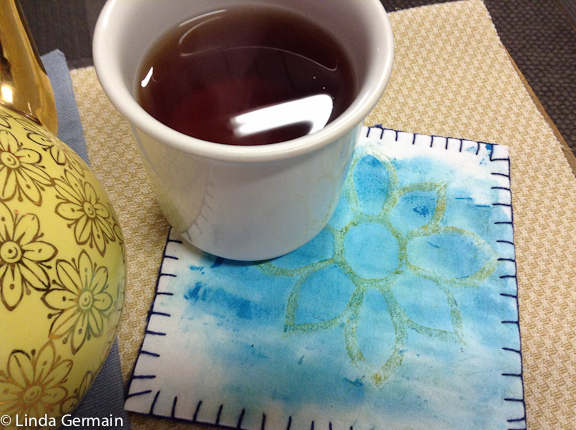
hand sewn coaster with printed fabric

I like the rustic feel of the blanket stitch for this over sized coaster. It would be good for putting hot things on. Not sure how washable it would be. But I am enjoying it for today.

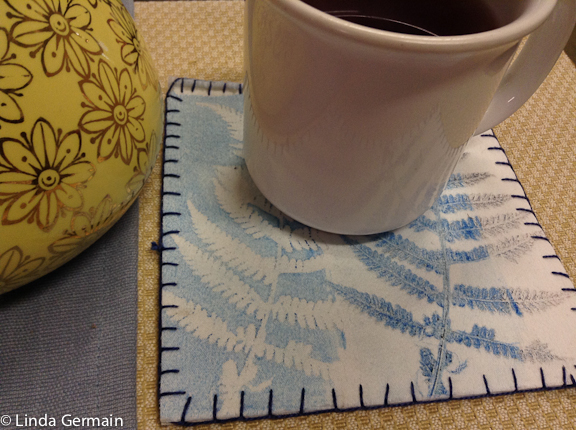
reversible coaster with gelatin printed fabric

Check out current online workshops.


No sew hand printed mug rug Read More »