Limit the elements to simplify the monoprint

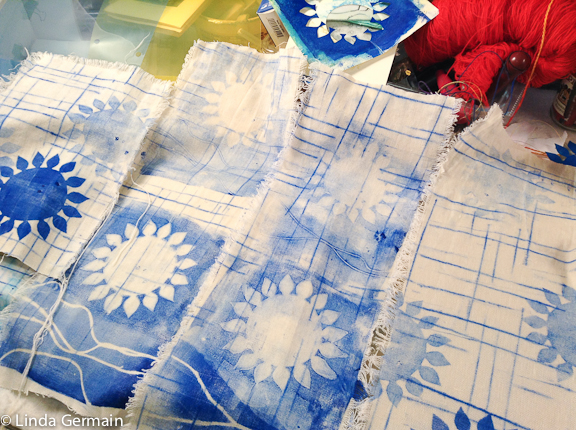
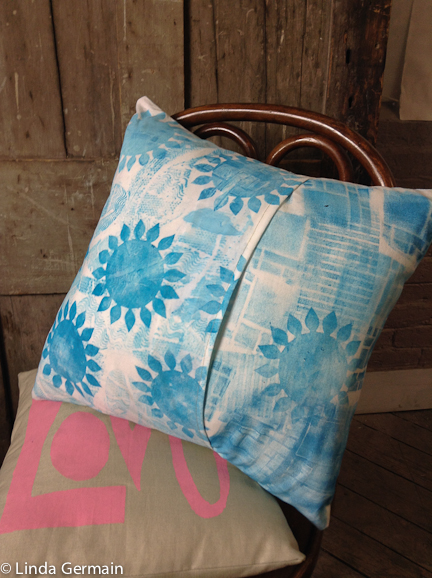
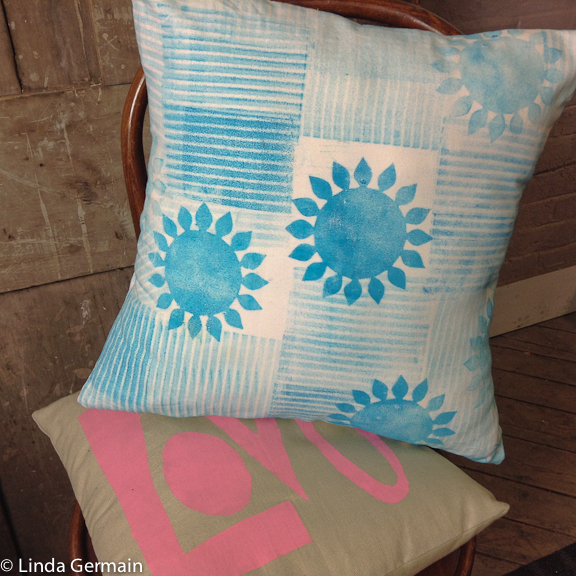
I made another pillow cover with some monoprinted fabric. I wanted to see if I could simplify the design.

I would say I was able to simplify the pillow cover in many ways, compared to the pillow I did last week.

process of gel printing on fabric

This is what I did differently:

  • I used full size fabric pieces so I did not have to piece the cover together
  • I used just one color
  • I limited my tools to 3 stamping/rubbing tools and one stencil

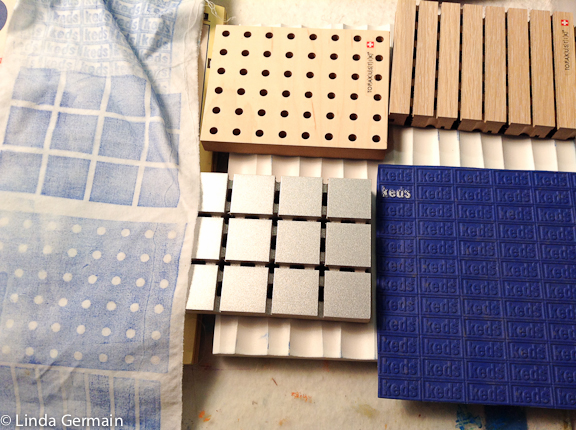
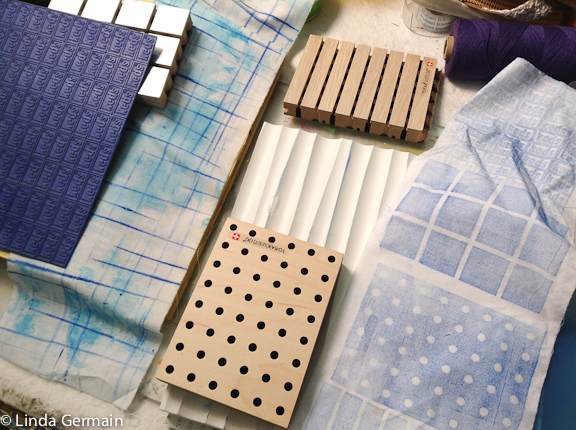
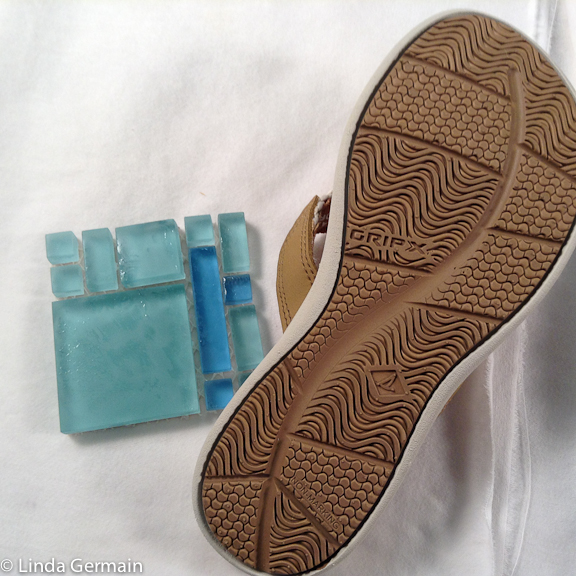
I found a couple of interesting mark making tools at Extras for Creative Reuse, our local recycle store. I just loved the designs and patterns on this Sperry Sandal. And the geometric patter of this tile piece inspired me.

found object marking tools for printmaking

I tested them out and they worked OK, not a fabulously as I had hoped. But they could still inspired some foam relief plates.

back side of pillow cover with monoprinted cloth

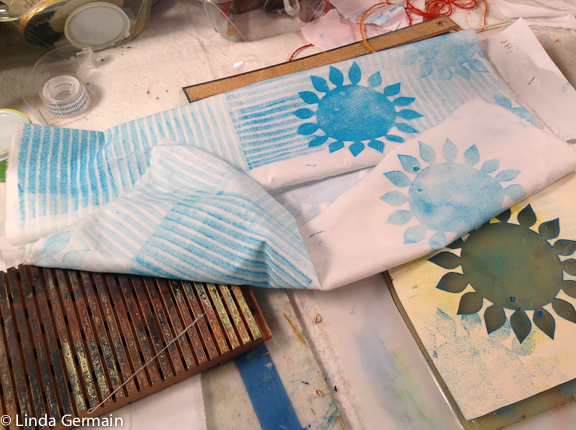
I mainly used them to create light brayer rubbings in the background. I relied on the the bold flower stencil to create the darker marks and the focus of the fabric print.

pillow sham sewn with monoprinted fabric

I had the straight line “tool” in my stash of found object mark making tools. I am sure I got it at Extras for Creative Reuse a while back. I like how I have a uneven =, dynamic balance of marks, motion and value.

You still have time to join us in Monoprinting on Fabric. Class starts soon. Read the details on the printmaking workshop page and register today.

You will make your own fabric for pillows and more.

Students are liking Monoprinting on Fabric

Gelatin Printing on Fabric Loved it! 3 key approaches I have learned

  • bubbles/imperfections in the gelatine plate can be a good thing – it does NOT have to be perfectly smooth,
  • doing a brayer rubbings on a piece of fabric and
  • finally being able to get a coordinated set of prints.

Thank you everyone in the class for your comments and adding to the learning process. Erin J. from Australia


Monoprinting Fabric has been a wonderful class…so well presented.

I have thoroughly enjoyed it!

from Candee L from the US


Check out some student work in this video.

Limit the elements to simplify the monoprint Read More »

Video of Student Monoprints on Fabric

Monoprinting on fabric is fast and experimental.

Check out some prints made by the participants of the last session of Monoprinting on fabric, the online printmaking course.

Monoprintng on Fabric – Student work from Linda Germain on Vimeo.

If this looks fun to you, then you are in luck. The next session of this printmaking class starts soon. Read the details and join us today.

Students are learning a lot:

kathyirving-2 happy printmaking student

Monoprinting Fabric is an enjoyable and valuable learning experience. I will miss the daily anticipation of what new technique was coming next. Linda provided an excellent foundation to build on, and I am grateful for her expertise and willingness to share it with us. I look forward to another class with you. Kathy I. from the US

Gelatin Printing on Fabric Loved it! 3 key approaches I have learned

  • bubbles/imperfections in the gelatine plate can be a good thing – it does NOT have to be perfectly smooth,
  • doing a brayer rubbings on a piece of fabric and
  • finally being able to get a coordinated set of prints.

Thank you everyone in the class for your comments and adding to the learning process. Erin J. from Australia

Video of Student Monoprints on Fabric Read More »

New habits and old

I am trying to trick myself into new habits. I confess, I do enjoy watching TV.

Instead of making myself bad and wrong for enjoying TV, I had the idea to add an activity to the mindless, but enjoyable TV watching.

I have tried 2 different activities, that I think will feed my art making process:

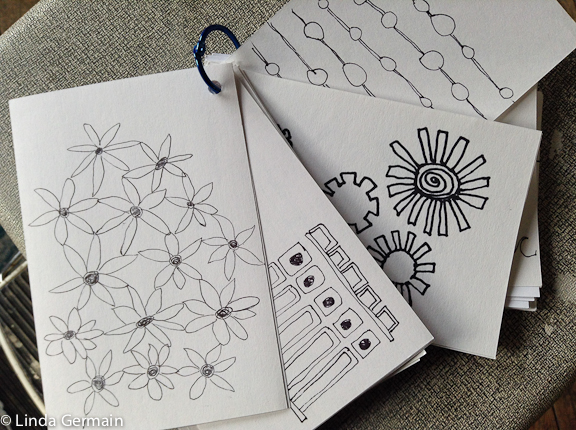
  1. Making drawings and doodles without judgement on index cards
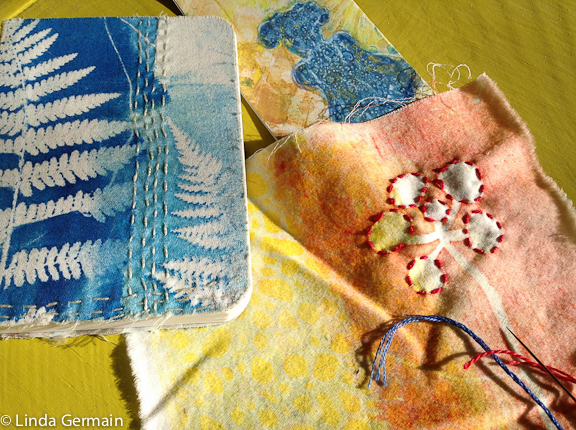
  2. Hand stitching on monoprinted cloth

monoprinting fabric with hand sewing linda germain

I am pretty pleased with my ability to trick myself into action.

The monoprinted fabric flower above was easy to experiment with. I started with some french knots, but did not like how they looked. So I quickly pulled them out and tried the primitive running stitch.

pack of doodlesby linda germain

I am super excited about this “Doodle Pack.”

I was helping out at Extras for Creative Reuse, the local recycling center, and I was tempted by a stack of 4″ designs on transparent plastic.

I thought, Wow!

These would be great for inspiring printing plates, and stencils and screens.

BUT, I am trying to get rid of stuff not collect more stuff.

So, I decided to make my own stack of small designs and doodles that could inspire printing plates, screens and stencils.

It is so simple. All you need is:

  • a package of index cards,
  • hole punch
  • loose leaf ring clip
  • pen, sharpie or pencil

I love about this format because it is so easy  to just throw away wicked ugly doodles. Also it is small and easy to carry around. It seems to move me away from thinking that every drawing needs to be good, precious or worthy.

It is empowering to be able to just do a quick doodle and move to another page without judgement.

I would love to provide you with instruction and support with your art making goals. Check out the full schedule of online workshops. Hopefully you find a class that fits your needs.

The next class is Monoprinting on Fabric with the Gelatin Plate. Class starts next week – Jan 9th! Join us for some fun experimental printmaking.

Students are getting a lot:

Marsha happy student in Make Monotypes with Linda GermainIf you think that you can’t learn in an online environment, think again!

You will be amazed at how much you learn from Linda. Each day she shows you techniques, through her very informative videos. You can play the videos again and again to further understand the process.

I learned the basics – making a plate, rolling ink (this took some practice!) and pulling a print. I am pleased with this. I feel that I can really move on and explore this technique in greater depth on my own.

Marsha Hardin Reske – Make Monotypes 

More testimonials here.   Hope to see you in a class soon!


New habits and old Read More »

2016 Year End Review in Pictures

Happy New Year!

I scrolled through my 7300 pictures and did a 1 minute slide show of things that make me smile in 2016. Enjoy!

2016 Review from Linda Germain on Vimeo.


Hope you had a wonderful 2016 and holiday season. If you are ready to start monoprinting on fabric, then you are in luck.

Class starts next week and you still have time to join this printmaking workshop. (It is the only time it will be offered in 2017)

Read all the details and register on the Printmaking workshop page.

2016 Year End Review in Pictures Read More »

Add hand sewing to Monoprinted fabric projects

Hand sewing can be as simple as the running stitch. It may be simple but a few stitches can really transform a printed fabric project.

monoprinting fabric with hand stitching

For this pillow cover I pieced several monoprinted squares of cotton together.

Then I used the circle motif to repeat an underlying elements and unify the the design. The ideas evolved as I printed the fabric, pieced the squares and finished the pillow.

waxed the tip of the thread

I used a little wax on the end of my embroidery floss to get the fibers to stay together for a little easier threading.

I got the idea from my bookbinding tool kit. We use this chunk of beeswax to coat the thread for book binding. Just pull the end of the thread through the cold wax a few times and smooth with your warm fingers.

circle making tools from the studio

I found some round circles from around the studio to make my sewing lines. I traced a small plate, a cd and a whiffle ball, to make 3 different sized circles.

used water based marker to make the sewing lines

I tested my green water based marker first on a piece of scrap fabric. I wanted to make sure that I could easily rinse out the sewing lines when I was done. The pencil did wash out but it required more scrubbing.

Be sure to test your marking tools before you draw on your original art work.

back side of hand printed pillow cover

I was pleasantly surprised with how the back side of the pillow cover turned out. I used the bolder solids on the back. I think it works. There is some variety and repetition of marks and I like how the pieces of fabric are different sizes.

Want to make your own monoprinted pillow cover?

YES! then check out the online self study Monoprinting on Fabric.

Students are getting a lot from Monoprinting Fabric Course

kathyirving-2 happy printmaking student

Monoprinting Fabric is an enjoyable and valuable learning experience. I will miss the daily anticipation of what new technique was coming next.

Linda provided an excellent foundation to build on, and I am grateful for her expertise and willingness to share it with us. I look forward to another class with you. Kathy I. from the US


Monoprinting on Fabric has been a fabulous course. There is a lot there to keep me going for a very long time. I love your teaching style, very encouraging, supportive, clear and fun. Patricia G. from the UK

Add hand sewing to Monoprinted fabric projects Read More »