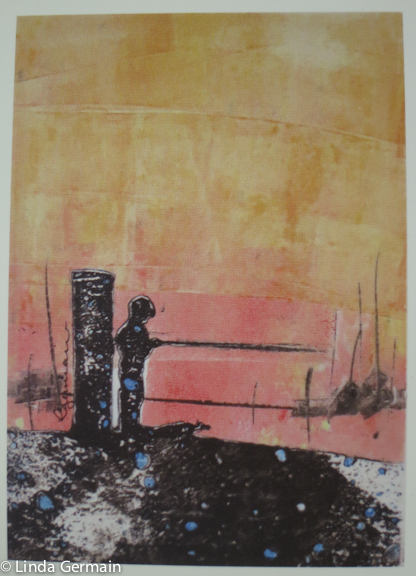
Fishing Print available at local art market

Mini fishing print - Linda GermainThe committee of the Haverhill Artist Market have decided to have some fun with the art market in January.

They are having a beach party. So I am gathering some of my beach and summer themed art to have it available for purchase at the

This is a re-print of an original monotype that I made of my brother fishing off the pier in Rye Harbor many years ago.

I have matted these small prints to 5″ x 7″ and they will be affordably priced and available at the art market.

What would you do to have a beach party in January?

As the temperature drops and the heating bill rises, I look forward to this beach party!

Fishing Print available at local art market Read More »

Thermofax screen to make business cards

I am lucky enough to have a Thermofax machine. It is an old style copy machine that mixed media artists and tattoo artist use to burn/transfer screen printing screens and images for our work.

There are lots of artists who burn screens for folks who don’t have a machine. That is what I would suggest for anyone who wants to try out the process. Get a couple of screens and play. See if you use the process as much as you think.

This Kit is no longer available.

What I love about thermofax screens:

  • the level of detail
  • the ease of creation
  • the non toxic process

If you would like to explore thermofax screen printing and several other screen printing techniques then join us in the next session of pulling screen prints, the online screen printing course. Get the details of the printmaking class here.

Thermofax screen to make business cards Read More »

Use a sheet of Mylar to register impressions – screen printing


One way to register impressions is to use a sheet of mylar or plastic to line up the mark. This video gives you a glimpse of the process.

If you are interested in learning more about screen printing techniques then join us in the next session of Pulling Screen Prints, the online screen printing class.

We will explore paper stencils, experimental monotypes, thermofax screen and more. Check out the details here.

Screen Printing on Fabric napkins - Linda Germain

Use a sheet of Mylar to register impressions – screen printing Read More »

Screen Printing Techniques – online course

Thermofax Screen printing kit for Pulling Screen Prints the online Printing courseToday I am making up some thermofax kits for the online screen printing class, Pulling screen prints. When you join this course you will get an 8 piece thermofax kit.

Class starts on January 11th, so you still have time to join us. It is a 4 week printing workshop to explore several easy screen printing methods. We will:

  • Start with paper stencils
  • Explore drawing fluid and screen filler methods
  • Experiment with monotypes and wax resist
  • Combine and layer thermofax impressions

In the image above I use the following screen printn:

  • Green rectangle was created with a taped screen
  • Blue circle is an old drawing fluid and screen filler image on an embroidery hoop screen
  • Black Butterfly is a thermofax screen
  • Text was made with an EZ-screen kit

I also used the inks, paints and modifiers below.

screen printing inks and paints linda germain

I think it is best to use the right inks for the process, but sometimes I just try what I have at hand.

I love the Createx acrylic colors screen printing ink. The squirt bottle is handy and creates less waste. But the bottles are big and on the expensive side. So I would say buy them if you are sure you are going to do plenty of screen printing.

Versatex makes several different inks for printing on different materials. They have starter kits and are a good choice if you are just exploring the screen printing methods and still not sure if the process is for you.

Golden makes a silkscreen medium that you can mix with regular acrylic paint. The jar says it is for printing on paper and wood. I am not sure what it would do to fabric. I think there will be some learning and experimenting with the mixing ratio and the type of acrylic paint, but this seems like a good choice if you already have a lot of acrylic paint in the studio.

The ideal ink will flow through the screen, hold the edge of your design, and dry slowly so that it does not clog and ruin the screen.

Join us in the next session of Pulling Screen Prints! Get the support you need to add this process to your skill set.

Screen Printing Techniques – online course Read More »