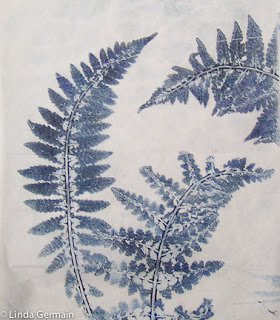
I like to just play when I am gelatin printing. But I do think that I have a few compositional rules in the back of my head that guide me.
One of the rule that I use keep is simple. Often my gelatin monotypes can get dull, muddy or chaotic. So I work up lots of prints and learn from each one. Then take what I learned and create a simplified version keeping the marks that I like and avoiding the ones I don’t like. So If you look at some of my printsyou will see that often I use two colors and 2 to 3 stencils of shapes.
Merry Christmas and hope everyone is relaxing, skiing or having some kind of fun this vacation week. I am taking the time to regroup and organize for the new year.
Delicate Detail Impression on gelatin plate by Linda Germain
Supplies I used to create this great detail with the gel plate:
gelatin plate
ink
brayer
print paper
water
newsprint
plexi plate
The Gel Printing Process
This print is often referred to as the ghost print. I called it the ghost print too when I first started out. Ghost print is a printmaker term that is used to describe the light impression that is made from the left over ink after the original print is pulled. It is very similar to the original but lighter. I can understand how the term got attached to the second print but I feel that it is really not accurate. Therefore I refer to this second print as the detail print. I think that this term is a better description of the second print.
This print is the layer of ink that holds all of the details from the stencils and stamping tools.
So in order to get the detail print you have to pull the shape print first. After you have pulled the shaped print, remove the stencils, set them to the side.
Get a fresh piece of paper Place it on the gelatin plate and burnish edge to edge.
Sneak a peek – peel back one edge and see if you have picked up all the ink possible, if not then roll it back down and burnish some more. Eventually peel off the print and admire.
Dark ink detail prints are easier to see compared to yellow or gold ink prints.
Sometimes I will do a newsprint pick up before I pick up the stencils to get rid of some of the plate ink. This will give you a clean back ground and increase the contrast.
If you are interested in learning how to create your own fabulous monotype prints with the glycerin and gelatin plate then check out the details of Make Monotypes the online printmaking class with Linda Germain
I have been experimenting with wiping down the gel plate with an antibacterial wipe before I put it away for the night. I think it helps to slow down the aging process.
You may know that I LIKE it to age, see my prints made with moldy gelatin. But now I can slow down the process that makes the fun holes in the gelatin.
Happy Printing.
Join the List and get weekly info about courses, making gelatin plates and more.