Planning the details for Printing on Fabric Class – Linda Germain
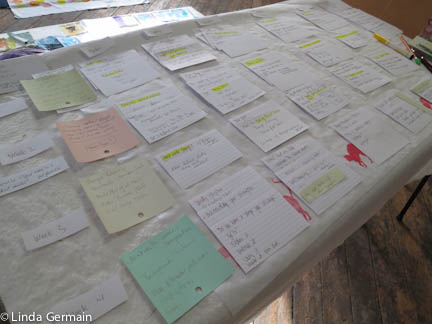
I am pleased to share that everything is falling into place for the upcoming Fabric Printing Class – Make Monotypes – Focus on Fiber.
The more I explore this process the more excited I get. I love to think of new ways to make marks with unexpected tools.
Working with fabric is much different than paper for me. Basic principles and tools carry over, but there are new challenges and new types of marks to take advantage of.
I have set the dates for the Online Printmaking Workshop, class will start January 12th and run for 4 weeks.
Early Bird Registration will open Friday, November 14th at 8:00 AM EST. So mark your calendars and plan for some printmaking fun this January.
Here is the schedule:
Week 1 – Let’s Get Printing – optimize your workspace, make the gelatin printing plates, find some super simple tools and begin to make the most of your inks and marks
Week 2 – Mask and Transfer delicate marks – choose and preserve natural materials, cut and use stencils to block and transfer ink as desired to create those amazing details that are only possible with this gelatin printmaking process
Week 3 – Make the most of your brayer, identify and create stamping tools that will print best on fabric, transform a small printing plate and create a large printed cloth
Week 4 – Play with painted and brayered abstracts, create textured backgrounds, explore alternative plate use and what to do with less than perfect prints. Identify your strengths and preferences and embrace your new printmaking skills.
Tell me what would you do with all your monoprinted fabric? Would you make quilts, wall hangings, mixed media art, embellish other fibers with it?
I am playing with all types of printmaking inks and paints for making prints on fabric with the gelatin and glycerin plate.
I am looking for inks that are compatible with the water based printing plate.
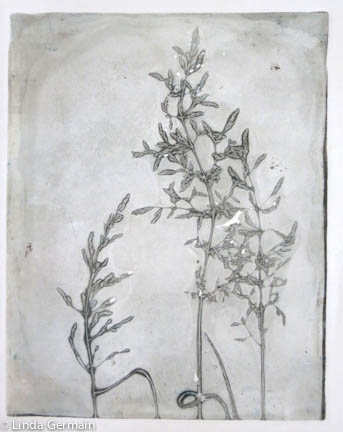
I am drawn to the type of fine detailed impressions that are possible on the homemade glycerin plate. I am always amazed at the fine details that are possible with mere hand pressure and the gelatin and glycerin plate.
It is important to me that the inks permit the printing of these types of detailed impressions.
The perfect ink will:
roll out thin layer with brayer
hold the edge of a detailed mark
stay alive/workable as long as possible
non-toxic and low fumes
dry fixed on the fabric
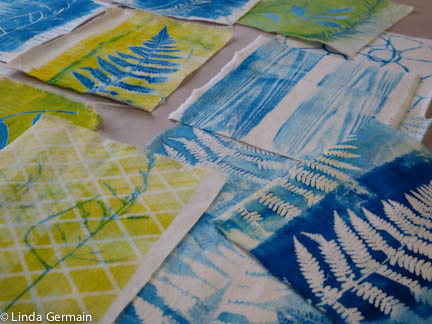
The monoprints in the photo were printed with the Versatex screen printing inks. I am pleased with these inks so far. A bonus is that they work well with paper too.
These screen printing inks have a nice consistency and they roll up nicely on the glycerin and gelatin printing plate.
What do you think could less be more for you in some areas of your artwork or life?
Make minimal monotypes
Share your thoughts below.
Would you like to explore gelatin printing with the homemade gelatin and glycerin plate in Make Monotypes, the online printmaking class. Check the workshop schedule and sign up.
This is what one student expressed about Make Monotypes, printmaking class:
“Now, I have the confidence to try different printing techniques and to even cut up the gelatin plate to get interesting shapes.” says Lynne P.
Make a Glycerin & Gelatin Printing Plate Now!
Get the FREE recipe to make a gel printing plate
Additionally, you will receive a weekly email about printmaking, ideas, tips and courses.
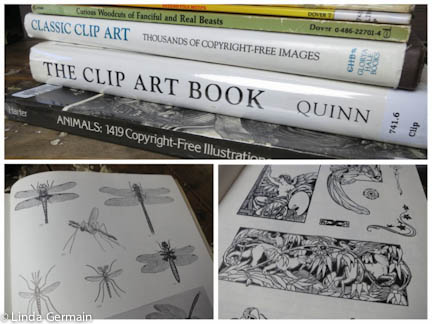
Copyright Free Clip Art is good for thermofax screen printing
A thermofax machine quickly “burns” screens for small scale screen printing. Choosing the right images will help create screens that will last for 100’s of prints.
You need a carbon based photocopy of a high contrast image for best results in creating the thermofax screen.
Here are some guidelines for choosing clip art images to use to create screens for printing
High contrast black and white image
Not a lot of big solid black area
Strong clean photocopy from a toner based copier
Copyright free or in the public domain
No bigger that 8″ x 10″
I think it is a good idea to start with small images, like 5″ x 7″ or smaller. It is easier to print this size with out the aid of a rigid frame.
Photos, drawings and stamped marks can be good sources of imagery for Thermofax printmaking. I hope to talk about these type of images in the next few weeks.
If you are interested in an online printmaking course in Thermofax screen printing, then join the special interest group. I am excited about creating this class for you. It is a low tech printmaking technique that is possible to do with out a press and still obtain detailed impression.