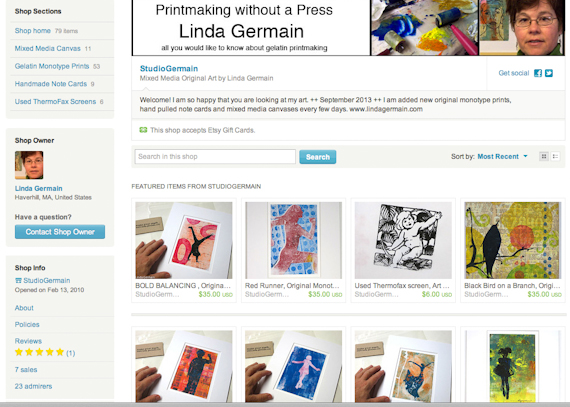
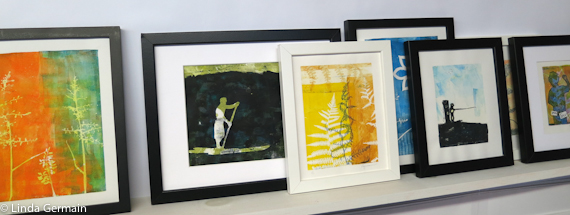
I have been adding new artwork to my shop on a regular basis so stop over and take a look. You might find a piece that you would like for your home or office. I have original monotype prints, Thermo fax screens and a few mixed media pieces.
I have been enjoying Pandora and Sara Bareilles, and I found the video above while I was searching for inspiring website themes and came across headway and Lisa Lavoie .
Doesn’t it just make you want to be brave and do something? I am still smiling!
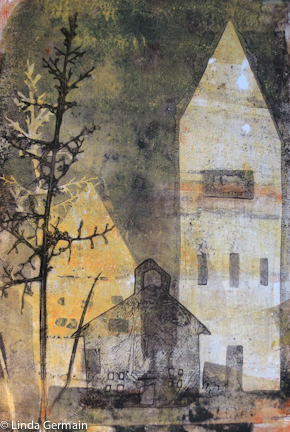
These are all gelatin plate monotype prints by linda germain.
I often forget that the average person does not know what an original print is. I was reminded of this at the crafter’s fair at the River Ruckus in Haverhill this past weekend.
I try to use familiar words and concepts to describe the monotype process, but I often lose them in the first few sentences. I should have had my video with me, or maybe some process pictures. I found a fun and interactive slideshow from the folks a MOMA. It explains what a print is and gives great examples.
Sometimes the mystery of printing on Jello, holds the viewer’s interest for a while. It is such a user friendly process – I need to find the words to create a bridge to understanding printmaking and monotype printing.
A gelatin monotype print is a one of a kind original print. It is created by making marks in a thin layer of ink on the surface of a plate of gelatin. Gelatin is soft and malleable and can hold delicate details. These details are transferred to paper by hand pressure alone. This is the beauty of gelatin printmaking, the transfer of delicate details by hand pressure alone. It is a water based non-toxic process that is experimental and user friendly. I think it is easier to watch the video.
Today, I am playing with a few simple stencils that I cut from a Tyvek® envelop. The envelop had a little texture that I think adds to the impression in the ink. I am also experimenting with limiting the colors and stencils. Boundaries can help the discovery process.
One wonderful thing about Tyvek® stencils for gelatin printmaking is that they are durable and long lasting. When I take all the time to cut stencils, then I want them to last for ever. Cutting stencils is not the fun part for me. If you would like some of my stencil cutting tips then check out this post.